Chevron Combo 1 Clay Cutter - Geometric: Evaluating Digital STL Options for Polymer Clay and Baking
The transition from purchasing physical tools to acquiring digital assets represents a significant shift in how makers approach polymer clay jewelry, cookie decorating, and fondant work. The Chevron Combo 1 Clay Cutter - Geometric bundle exemplifies this modern workflow, offering a comprehensive set of STL files rather than a tangible product. For artisans aged 20 to 50 who own or are considering purchasing a 3D printer, understanding the specific utility of this digital download is essential for determining if it fits their production needs better than traditional metal cutters or pre-printed plastic alternatives.
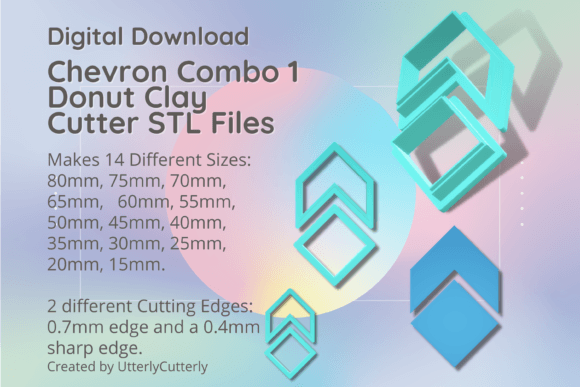
This digital package is distinct because it prioritizes versatility through scale and edge variation. Unlike standard retail cutter sets that often include only three or four fixed sizes, this bundle provides fourteen distinct dimensions ranging from 15mm to 80mm. Furthermore, it addresses the common frustration of "one-size-fits-all" cutting edges by including two distinct profile types within the same geometric design. When evaluating whether to integrate the Chevron Combo 1 Clay Cutter - Geometric into your digital library, it is necessary to weigh the technical specifications against your specific material requirements and printing capabilities.
Technical Specifications and Edge Variations
A primary decision factor when selecting 3D printed cutter files is the relationship between wall thickness, cutting edge sharpness, and structural integrity. This bundle offers two engineered solutions to accommodate different mediums. Understanding the difference is critical for avoiding print failures or material tearing.
- Standard Wall (0.7mm): This file features a 0.7mm wall with a 3mm thick base and a total height of 12mm. This specification is generally considered the "workhorse" option for polymer clay. The 0.7mm wall provides sufficient rigidity to prevent flexing during the cutting motion, which helps maintain the geometric integrity of the chevron shape. It is ideal for firmer clays or thicker sheets where a delicate edge might deform.
- Sharp Edge (SE): Abbreviated as SE in the file list, this version utilizes a 1mm support wall but tapers to a precise 0.4mm cutting edge. Like the standard version, it maintains a 3mm base and 12mm height. The sharper profile is superior for soft materials like fondant, gum paste, or conditioned polymer clay where clean release is paramount. However, users should note that 0.4mm edges require precise printer calibration; over-extrusion can blunt this edge, negating its advantage.
Both cutter types share a consistent 12mm height and 3mm base. The reinforced base is a crucial design element often overlooked in free or low-quality STL files. A 3mm base distributes thumb pressure evenly, reducing hand fatigue during repetitive cutting sessions and preventing the top of the cutter from digging into the user's skin. When comparing this to single-wall open-source designs, the ergonomic consideration here suggests a higher level of practical testing.
Sizing Strategy and Embossing Considerations
The inclusion of fourteen sizes (80mm, 75mm, 70mm, 65mm, 60mm, 55mm, 50mm, 45mm, 40mm, 35mm, 30mm, 25mm, 20mm, and 15mm) allows for graduated design work that physical sets rarely offer. Measurements are taken from the longest ends of the geometric shape, ensuring accurate scaling for earring components versus larger pendant or cookie applications.
For users intending to use these cutters for embossing rather than full cuts, there is a specific technical constraint to observe. Any embossing lines integrated into the design stand 10.5mm tall. Consequently, effective embossing requires a clay slab thicker than 1.5mm to prevent the cutter bottom from contacting the work surface before the impression is fully formed. This makes the tool less suitable for ultra-thin veneer work or skinner blends rolled to 1mm settings, highlighting a limitation compared to dedicated shallow embossers.
Digital STL Bundles vs. Physical Alternatives
Evaluating the Chevron Combo 1 Clay Cutter - Geometric requires comparing it not just to other digital files, but to the broader ecosystem of cutting tools. Each format presents distinct tradeoffs regarding cost, immediacy, and customization.
Comparison with Stainless Steel Cutters
Stainless steel remains the benchmark for durability and edge sharpness. Metal cutters typically offer a thinner cutting edge than even the SE version of this STL bundle, resulting in less material displacement and cleaner raw edges on polymer clay. However, steel cutters are limited in availability; finding a specific geometric chevron combo in fourteen graduated sizes is often impossible without custom fabrication. The digital bundle wins on design specificity and size range, while steel retains superiority in longevity and edge refinement. For high-volume commercial production where tool wear is a concern, steel may still be preferable. For designers exploring new shapes or requiring niche sizing, the STL format offers immediate access without inventory risk.
Comparison with Pre-Printed Plastic Cutters
Purchasing pre-printed plastic cutters eliminates the need for owning a 3D printer and managing print settings. However, this convenience comes at a premium per unit and removes the ability to replace broken tools instantly. With the Chevron Combo 1 Clay Cutter - Geometric digital download, the marginal cost of producing additional cutters drops to mere cents in filament after the initial file acquisition. Additionally, having the source files allows users to modify designs in CAD software if needed, such as adjusting the handle height or altering the chevron angle, a flexibility entirely absent with pre-printed purchases.
Comparison with Other Digital STL Providers
The marketplace for clay cutter STLs is saturated, making quality assessment difficult. Many available files lack reinforced bases or offer only a single wall thickness. This bundle distinguishes itself through the dual-edge option and the extensive size gradient. When comparing against other digital sellers, verify whether they provide both sharp and sturdy variants. Files that offer only one compromise setting often fail to satisfy either the jewelry maker needing precision or the baker needing durability. The weekly release schedule mentioned for this store also indicates an active designer, which correlates with better long-term support and updated design trends compared to static repositories.
Decision Factors: When This Bundle Is the Right Fit
Selecting the right tool resource depends heavily on your current equipment, material preferences, and business model. The Chevron Combo 1 Clay Cutter - Geometric is particularly well-suited for specific user profiles while presenting challenges for others.
Ideal Use Cases:
- Jewelry Designers Requiring Scale Variation: If you create coordinated sets (e.g., stud earrings, dangle earrings, and pendants using the same motif), the 15mm–80mm range eliminates the need to source multiple disparate tools.
- Makers with Tuned FDM Printers: Users who have already calibrated their printers for dimensional accuracy and thin walls will extract maximum value. The ability to print the SE version successfully depends on a well-maintained machine.
- Hybrid Medium Artists: Those who work across both polymer clay and baking/fondant benefit significantly from having both edge profiles available in the same design language.
- Budget-Conscious Startups: For new businesses minimizing overhead, investing in a digital library rather than physical inventory preserves capital while maintaining professional design capabilities.
Situations Requiring Alternatives:
- No Access to 3D Printing: Without a printer or access to a local printing service, this digital product has zero utility. Factor in the learning curve of printer maintenance if you are a novice.
- Ultra-Fine Detail Work: While the SE version is sharp, FDM printing has inherent layer lines. Makers requiring glass-smooth cuts without post-processing sanding may still prefer laser-cut acrylic or stamped metal options.
- Thin Slab Embossing: As noted regarding the 10.5mm emboss line height, those working exclusively with sub-1.5mm clay sheets will find this tool incompatible with their process.
Practical Implementation and Workflow Integration
Integrating digital cutter files into a physical workflow requires attention to print orientation and material selection. For the Chevron Combo 1 Clay Cutter - Geometric, printing with the cutting edge facing up (base on the build plate) is standard to avoid supports on the functional surface. Using PLA is typical for clay, but PETG may be preferable for fondant applications due to food safety considerations and slightly higher heat resistance during washing.
Users should also consider post-processing. Even with optimal print settings, the 0.4mm SE edge may have minor artifacts. Light sanding with high-grit paper or brief exposure to acetone vapor (for ABS/ASA) or specialized PLA smoothing agents can enhance performance. However, many makers find that the as-printed quality of well-tuned files is sufficient for polymer clay, especially when using cornstarch or water as a release agent.
Ultimately, the value of this digital bundle lies in its adaptability. By providing multiple edge geometries and a comprehensive size range, it acknowledges that "geometric chevron" is not a monolithic category but a design system that must serve various functions. Whether creating delicate 15mm studs or substantial 80mm cookies, the ability to produce the exact tool needed on demand represents a fundamental advantage in modern craft production. Evaluating this resource against your specific technical constraints and creative goals will determine if it earns a permanent place in your digital asset library.