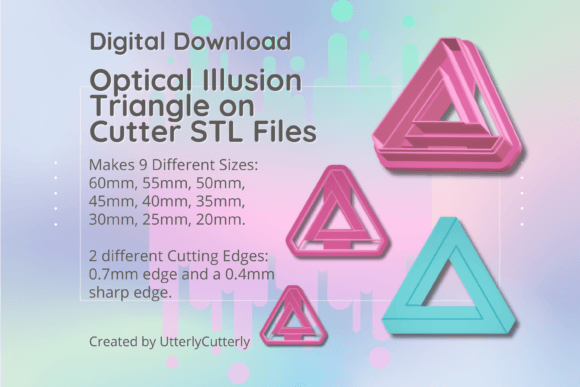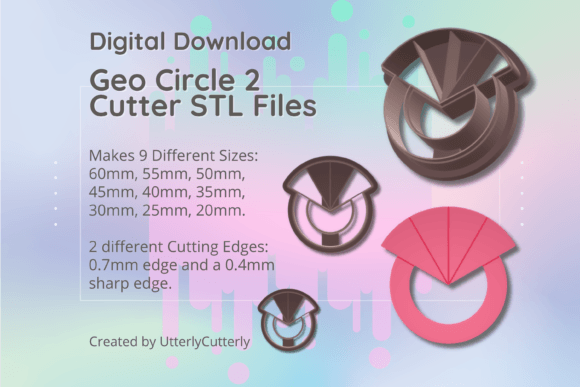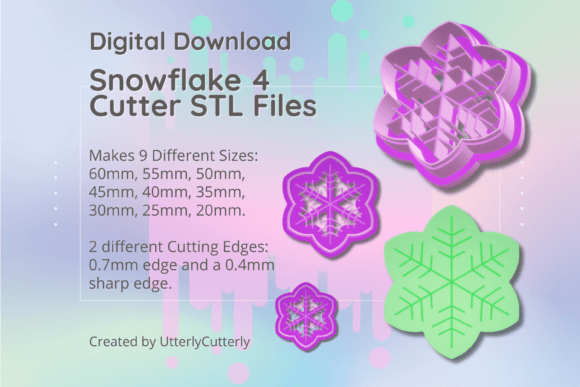
Evaluating the Clay Cutter STL File Large Snowflake Tri for Polymer Clay and Baking Projects
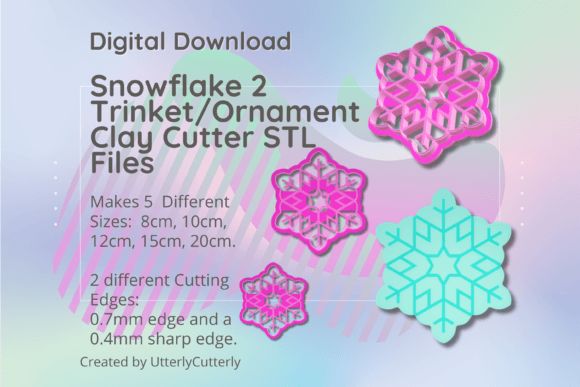
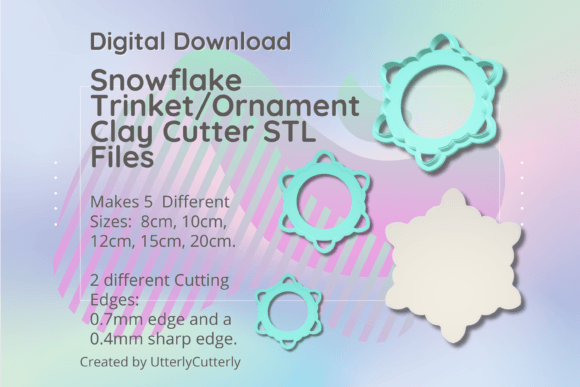
The Clay Cutter STL File Large Snowflake Tri represents a specific category of digital fabrication tools designed for makers who require precision in both polymer clay crafting and culinary applications. Unlike generic seasonal cutters, this digital download bundle focuses on technical versatility, offering five distinct sizes ranging from 8cm to 20cm and two specialized cutting edge profiles. For adults managing home studios or small businesses, understanding the technical specifications of these STL files is essential for determining whether they align with current production capabilities and project requirements.
This digital asset is not merely a decorative shape; it is a functional toolset engineered for 3D printing. The inclusion of multiple size variants allows creators to curate custom combinations for trinket trays, wall hangings, Christmas ornaments, and jewelry dishes without needing to source physical inventory. However, selecting the right cutter file involves evaluating printability, material compatibility, and the specific tradeoffs between sharp-edge and standard designs. This analysis explores where the Large Snowflake Tri fits within a broader maker workflow and how it compares to alternative shaping methods.
Technical Specifications and Printability Assessment
When evaluating any clay cutter STL file, the primary concern is often print success and durability. The Large Snowflake Tri bundle addresses common failure points in intricate geometric designs by providing two distinct cutter types. Understanding the difference between these profiles is critical for achieving professional results.
Standard Edge vs. Sharp Edge (SE) Profiles
The bundle includes two variations that serve different mechanical purposes during the cutting process:
- Standard Profile: Features a 0.7mm wall thickness with a 3mm thick base and a total height of 12mm. This design prioritizes structural rigidity. The thicker wall reduces the risk of layer separation during printing and provides more surface area for hand pressure when cutting through denser materials like cold porcelain or stiff polymer clay.
- Sharp Edge (SE) Profile: Abbreviated as SE in the file names, this version utilizes a 1mm support wall tapering to a 0.4mm cutting edge. While maintaining the same 3mm base and 12mm height, the reduced contact surface creates a cleaner slice with less material displacement. This profile is generally superior for detailed work but requires precise printer calibration to avoid fragile edges.
Makers must weigh the tradeoff here: the Standard profile offers longevity and ease of printing on entry-level FDM machines, while the SE profile offers superior finish quality at the cost of potential fragility. If your 3D printer has a well-tuned extruder and cooling system, the SE variant is often the better choice for jewelry dishes where edge definition matters. For high-volume cookie production or thicker clays, the Standard profile may offer better long-term utility.
Sizing and Embossing Compatibility
The five included sizes (8cm, 10cm, 12cm, 15cm, 20cm) are measured from the longest ends of the snowflake geometry. This measurement standard is vital for planning slab dimensions. Furthermore, users should note that any embossing lines integrated into related designs in this series are typically 10.5mm tall. This specification dictates a minimum clay thickness of 1.5mm to prevent bottoming out. When comparing this STL pack to others, verify that your preferred clay conditioning thickness aligns with these tolerances to avoid wasted prints or failed impressions.
Comparative Analysis: Digital STL vs. Physical Alternatives
For makers deciding between purchasing physical cutters and downloading the Clay Cutter STL File Large Snowflake Tri, several operational factors distinguish the two approaches. Digital files shift the manufacturing burden to the user but offer significant advantages in customization and cost-efficiency over time.
Customization and Inventory Management
Physical cutter sets are static; if a project requires a 13cm snowflake and the set only contains 12cm and 15cm options, the maker is limited. With the STL format, scaling is theoretically possible within slicer software, though the provided discrete sizes are optimized for structural integrity. More importantly, digital files allow for immediate iteration. New STL files are added to the store weekly, enabling creators to expand their catalog instantly without waiting for shipping. For those curating unique cutter combos, this ecosystem approach facilitates mixing and matching sizes across different designs in ways pre-packaged physical sets cannot match.
Material Versatility: Clay vs. Culinary Use
A distinct advantage of this specific STL bundle is its dual-purpose engineering. Many clay-specific cutters have thin blades that deform under the pressure required for dough, while cookie cutters often lack the precision needed for jewelry. The 12mm height and reinforced 3mm base of the Large Snowflake Tri provide sufficient clearance for rolled fondant and cookie dough while maintaining the rigidity needed for polymer clay. Makers who operate hybrid studios—creating both ceramic/polymer goods and baked items—will find this crossover functionality more efficient than maintaining separate tool inventories.
Decision Factors: When This Bundle Is the Right Fit
While digital fabrication offers flexibility, it is not universally superior. Evaluating whether the Clay Cutter STL File Large Snowflake Tri is appropriate depends on specific user constraints and goals.
Ideal Use Cases
- High-Volume Seasonal Production: For makers preparing for holiday markets, the ability to print replacement cutters on demand eliminates supply chain risks. If a cutter breaks mid-production, a new one can be fabricated in under an hour.
- Custom Sizing Requirements: Projects requiring specific dimensional ratios benefit from having five pre-optimized sizes rather than relying on a single scalable master file, which can distort intricate snowflake geometry.
- Multi-Media Studios: Creators working across polymer clay, air-dry clay, and baking will appreciate the dual-edge options that cater to different material viscosities.
Limitations and Alternative Considerations
Conversely, this digital download may not be the optimal solution for every situation. Users without access to a reliable FDM or resin 3D printer will face additional costs and learning curves that negate the benefits of digital files. In such cases, purchasing finished metal or plastic cutters remains the more practical route.
Additionally, while PLA and PETG are suitable for polymer clay, food safety is a nuanced consideration for the baking aspect of this bundle. 3D printed parts have layer lines that can harbor bacteria. If using these cutters for commercial food production, makers must implement proper sanitation protocols or use the cutters exclusively with non-porous barriers. Metal stamped cutters remain superior for commercial kitchens where dishwasher sanitation is mandatory. Therefore, this STL pack is best positioned for artisanal, small-batch, or hobbyist culinary use rather than industrial food processing.
Optimizing Workflow with Digital Cutter Files
To maximize the value of the Clay Cutter STL File Large Snowflake Tri, users should integrate specific workflow adjustments. Because the cutting edges are precisely defined (0.7mm or 0.4mm), slicer settings must respect these dimensions. Using variable layer heights or adaptive layers can improve print time without sacrificing edge accuracy. For the SE variant, increasing wall count to three perimeters ensures the 1mm support wall maintains integrity despite the fine cutting tip.
Post-processing also differs from physical tools. Printed cutters may require light sanding on the rim to remove layer artifacts that could texture the clay unintentionally. Investing time in finishing the printed tool once yields consistent results across hundreds of uses. By treating the STL file as a raw component rather than a finished product, makers can achieve professional-grade consistency that rivals or exceeds mass-manufactured alternatives.
Ultimately, the decision to utilize this digital bundle hinges on a maker's willingness to engage with the fabrication process. For those equipped with 3D printing capabilities and a need for versatile, multi-size snowflake geometries, the Large Snowflake Tri offers a balanced combination of structural engineering and aesthetic detail. It serves as a foundational element in a growing digital library, supporting everything from delicate jewelry components to substantial holiday decorations, provided the user navigates the technical requirements with informed intention.