2cm Wide Rounded Rectangle Clay Cutter: Evaluating Digital STL Options for Polymer Clay and Baking
When curating a collection of tools for polymer clay jewelry, ceramic work, or fondant decoration, the specific geometry of a cutter dictates the final aesthetic and structural integrity of the piece. The 2cm wide rounded rectangle clay cutter represents a distinct category of shaping tool that balances geometric precision with organic softness. Unlike standard rectangles that can appear rigid or harsh, the rounded corners provide a modern, approachable silhouette that is currently dominant in earring and pendant design. For makers utilizing 3D printing technology, acquiring this shape via a digital STL bundle offers significant advantages over purchasing individual physical cutters, particularly regarding size versatility and edge customization.
This digital format shifts the evaluation criteria from shipping times and stock availability to printability, dimensional accuracy, and application-specific design features. Understanding the technical specifications of these files is essential for determining whether this digital resource aligns with your production needs compared to traditional metal cutters or single-size plastic alternatives.
Digital Versatility Versus Physical Limitations
The primary distinction between a digital STL bundle and physical cutter sets lies in the breadth of sizing options available for immediate use. Physical cutter manufacturers typically sell rounded rectangles in isolated sizes or small, pre-determined sets. If a designer requires a graduated set of earrings or nested pendants, they often must source tools from multiple vendors, resulting in inconsistent corner radii and varying steel gauges.
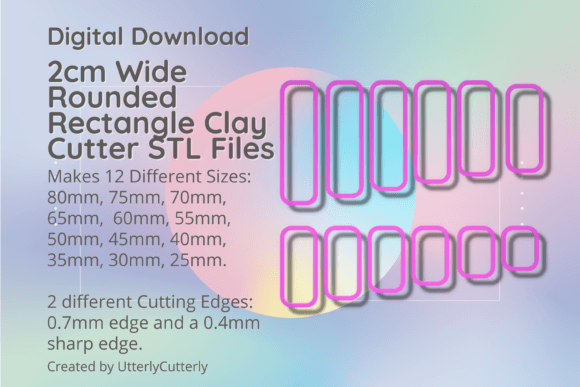
In contrast, a comprehensive 2cm wide rounded rectangle clay cutter STL pack addresses this consistency issue by providing twelve distinct lengths within a single download. The included sizes—80mm, 75mm, 70mm, 65mm, 60mm, 55mm, 50mm, 45mm, 40mm, 35mm, 30mm, and 25mm—all maintain the fixed 2cm width. This parametric consistency ensures that the aspect ratio and corner curvature remain identical across the entire range. For creators developing cohesive collections where visual harmony is paramount, this uniformity is difficult to achieve with disparate physical tools.
However, the tradeoff for this variety is the requirement of personal fabrication. Makers without access to a reliable FDM (Fused Deposition Modeling) printer or the time to manage print queues may find physical cutters more efficient despite their limitations. The digital option is best suited for those who view tool creation as part of their workflow rather than an obstacle.
Evaluating Cutting Edge Profiles for Different Materials
Not all cutting tasks require the same blade geometry. A significant advantage of high-quality STL files is the inclusion of specialized edge profiles designed for specific material behaviors. This particular bundle offers two distinct cutter types, each serving different functional purposes in clay and baking applications.
The Standard 0.7mm Wall Profile
The first option features a 0.7mm wall thickness with a 3mm base and 12mm height. This profile prioritizes durability and ease of post-processing. In polymer clay work, a slightly thicker wall creates a cleaner separation from the bulk clay block and reduces the risk of the cutter warping during the pressing motion. This edge is generally preferable for:
- Firmer clays: Materials like Sculpey Soufflé or firmer Kato Polyclay resist thin blades; the 0.7mm wall provides necessary rigidity.
- Cookies and fondant: Edible doughs are softer and do not require razor-sharp edges. The sturdier wall prevents dough from sticking inside the cutter and withstands repeated washing.
- Beginners: Thicker walls are more forgiving during the printing process and less prone to layer separation.
The Sharp Edge (SE) Profile
The second option, abbreviated as SE in the file names, utilizes a 1mm support wall tapering to a 0.4mm cutting edge. This design mimics the performance of commercial metal cutters. While more challenging to print successfully due to the fine nozzle requirements, it offers superior performance for detailed work. The SE profile is the optimal choice when:
- Working with soft clay: Soft conditioning clays or translucent varieties tend to drag and distort with thick plastic walls. A sharp edge slices through cleanly.
- Minimizing cleanup: A sharper cut reduces the burr left on the clay edge, significantly decreasing sanding time after baking.
- Precision stacking: When creating layered designs where exact alignment is critical, the reduced displacement of the sharp edge maintains dimensional accuracy better than a wedge-shaped thick wall.
Makers should evaluate their primary medium before printing. Those working exclusively with jewelry-grade polymer clay will likely prefer the SE files, while mixed-media artists incorporating baking or thicker ceramics may find the standard 0.7mm wall more versatile.
Technical Considerations for Embossing and Print Success
Beyond simple cutting, many rounded rectangle designs serve dual purposes as texture tools. It is vital to note that if the selected STL files include embossing lines, they are designed with a height of 10.5mm relative to the 12mm total cutter height. This leaves a clearance of only 1.5mm. Consequently, these cutters are engineered for clay sheets thicker than 1.5mm. Attempting to use them on thinly rolled clay (e.g., 1mm settings on a pasta machine) will result in the embossing feature punching through the material or causing uneven distortion.
From a fabrication standpoint, the 3mm thick base included in both profiles serves a critical ergonomic and mechanical function. A narrow top edge can be painful to press into firm clay and may cause finger fatigue during production runs. The widened base distributes pressure evenly. Furthermore, this base acts as a brim alternative, improving bed adhesion during printing. When evaluating this digital product against others, verify that the base design accounts for first-layer squish; a well-designed 3mm base should print reliably without requiring excessive manual brims that require trimming.
Decision Factors: When to Choose Digital Over Physical
Selecting between a digital 2cm wide rounded rectangle clay cutter bundle and physical alternatives depends on several practical variables. There is no universally superior option, only the option that best fits current constraints and goals.
Choose the Digital STL Bundle If:
- You require a complete, mathematically consistent size gradient for nesting or graduated jewelry sets.
- You need the flexibility to switch between sharp and durable edge profiles based on the specific project material.
- You already own a calibrated 3D printer and have experience printing functional parts with small nozzles (0.4mm or smaller recommended).
- You want to avoid international shipping costs and wait times associated with specialty tool vendors.
- You plan to iterate on designs or combine this shape with other STL assets in your library.
Consider Physical Cutters Instead If:
- You lack 3D printing equipment or the technical knowledge to troubleshoot print failures.
- You require food-safe certification that printed PLA/PETG cannot guarantee due to layer lines harboring bacteria.
- Your volume of production is extremely high, and stainless steel durability outweighs the cost benefits of plastic.
- You need immediate access to tools without any lead time for printing and post-processing.
Maximizing Utility Through Custom Curation
One often-overlooked benefit of integrating digital cutters into a studio workflow is the ability to curate custom combinations. Because the 2cm wide rounded rectangle is a foundational geometric primitive, it pairs logically with various other shapes. Makers can mix these STL files with arches, ovals, or organic forms to create unique composite tools or coordinated product lines that would be prohibitively expensive to commission as custom metal dies.
Furthermore, the digital nature allows for archival storage. Unlike physical tools that can be lost, bent, or rusted, STL files can be backed up and reprinted indefinitely. As new designs become available weekly in compatible stores, the initial investment in this bundle compounds in value, allowing makers to expand their toolkit without accumulating physical clutter. For the research-oriented maker who values adaptability and precise specification control, the digital route offers a level of autonomy that off-the-shelf products simply cannot match.
Ultimately, the decision rests on balancing the convenience of ready-made tools against the customization potential of digital fabrication. By understanding the specific wall thicknesses, size ranges, and material compatibilities outlined above, you can determine whether this 2cm wide rounded rectangle clay cutter bundle serves as a foundational asset for your creative practice or if alternative solutions better suit your immediate production requirements.