Heart Frill 4 Clay Cutter STL: Technical Specs and Practical Application
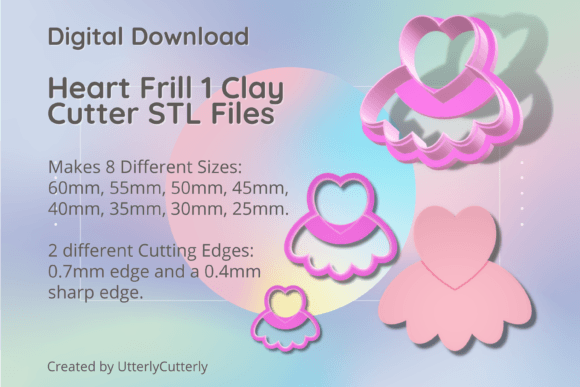
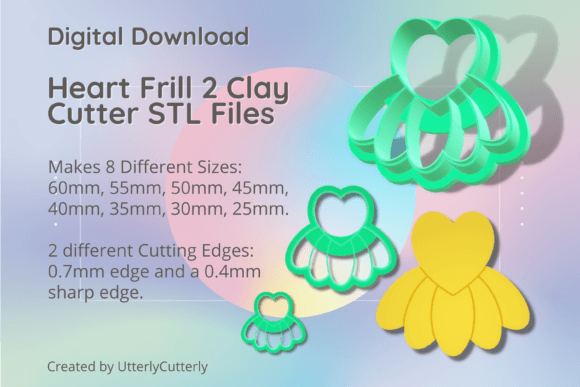
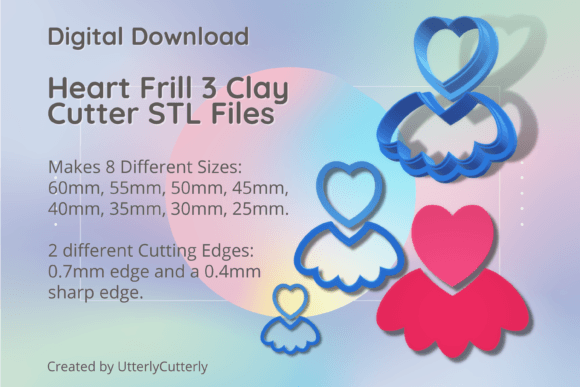
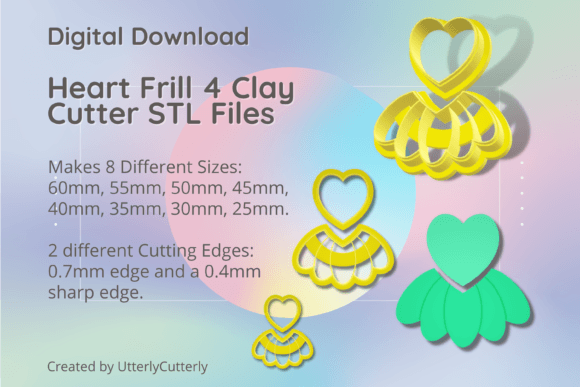
The Heart Frill 4 Clay Cutter - Valentines S represents a specific category of digital fabrication assets designed for polymer clay artists, cookie decorators, and small-scale manufacturers. Unlike generic shape cutters, this STL bundle focuses on the intersection of aesthetic detail and functional ergonomics. For professionals and serious hobbyists utilizing FDM or resin 3D printing, the value of a cutter file lies not just in the silhouette, but in the engineering of the cutting edge, wall thickness, and base stability. This digital download provides eight distinct sizes and two specialized edge profiles, allowing users to tailor their tooling to specific material behaviors and project requirements.
Evaluating Edge Profiles for Material Compatibility
A critical distinction in this STL pack is the inclusion of two separate cutter types. Understanding the mechanical differences between these profiles is essential for achieving clean results without excessive post-processing. The choice between them should be dictated by the medium being used and the desired finish.
The Standard 0.7mm Wall Profile
The first variant features a 0.7mm wall thickness with a 3mm thick base and a total height of 12mm. This specification prioritizes durability and ease of printing. For users printing in PLA or PETG, a 0.7mm wall offers sufficient structural integrity to withstand the pressure required for denser clays without deforming. The wider wall also acts as a slight embosser, creating a defined boundary that can help contain glazes or paints if used for ceramic applications. This profile is generally recommended for:
- Polymer Clay Jewelry: Provides a sturdy edge that resists snapping during the demolding process.
- Fondant and Gum Paste: The slightly thicker wall prevents the sugar paste from sticking excessively to the cutter interior.
- Beginner Printing: More forgiving of minor calibration issues or flow rate inconsistencies.
The Sharp Edge (SE) Variant
The second variant, abbreviated as SE in the file set, utilizes a 1mm support wall tapering to a precise 0.4mm cutting edge. Despite maintaining the same 3mm base and 12mm height, the functional performance differs significantly. The 0.4mm edge is engineered to slice through material rather than displace it. This reduces drag and distortion, which is paramount when working with soft or sticky mediums. Professionals will find this profile superior for:
- Intricate Detail Work: Minimizes compression at the perimeter, preserving fine textures near the cut line.
- Soft Polymer Clays: Reduces the "mushing" effect common with thicker-walled cutters.
- Clean Cookie Edges: Creates a sharper definition before baking, reducing spread-related shape loss.
Users must note that printing the SE variant requires a well-tuned printer. A 0.4mm cutting edge typically demands a 0.4mm nozzle with optimized retraction settings to prevent artifacts that could mar the clay surface.
Size Gradation and Workflow Versatility
The bundle includes eight incremental sizes: 60mm, 55mm, 50mm, 45mm, 40mm, 35mm, 30mm, and 25mm. Measurements are taken from the longest ends of the heart frill design. This graduated scaling serves a practical purpose beyond simple variety. In professional jewelry making, consistent sizing across a collection is vital for inventory management and product photography. Having a standardized 5mm step between sizes allows creators to produce nested sets or coordinated earring and pendant pairs without guessing proportions.
For cookie decorators, this range covers standard industry needs. The 60mm size functions well for standalone decorated cookies, while the 25mm and 30mm options are ideal for cupcake toppers or border accents. The ability to print these sizes on demand eliminates the need to source physical tools from multiple vendors, ensuring that the frill style remains consistent across all dimensions. Furthermore, because these are digital files, replacing a worn or damaged cutter involves merely reprinting the specific size needed, rather than repurchasing an entire physical set.
Embossing Line Considerations
An important technical specification for this model is the embossing line height of 10.5mm. With a total cutter height of 12mm, this leaves only 1.5mm of clearance above the embossed detail. Practically, this means the cutter is optimized for clay sheets thicker than 1.5mm. If using thinner clay, the embossing feature may bottom out or fail to register clearly. Users intending to work with very thin veneers should adjust their clay conditioning process or modify the STL in slicing software to reduce the overall Z-height, ensuring the cutting edge engages fully before the embossing limit is reached.
Printability and Digital Asset Reliability
The description notes that all cutters are tested, a significant factor when evaluating digital marketplaces. Untested STL files often suffer from non-manifold geometry, inverted normals, or walls that are too thin for reliable adhesion. The specified 3mm base on the Heart Frill 4 Clay Cutter - Valentines S indicates a design conscious of bed adhesion. A 3mm brim-like base reduces the risk of warping during printing, particularly for the larger 60mm variant which has a greater surface area subject to thermal contraction.
When preparing these files, users should consider the following printing parameters to maximize utility:
- Orientation: Print with the cutting edge facing up to avoid support material contact with the functional surface. The 3mm base provides adequate footprint for stability.
- Infill: 100% infill is recommended for the first 3-4 layers to ensure the base is solid, after which 15-20% gyroid or cubic infill is sufficient for rigidity.
- Material Safety: While PLA is standard, those using cutters for food items should verify local regulations regarding 3D printed plastics. Many professionals use these cutters exclusively for clay or employ food-safe barriers like plastic wrap when working with edibles.
Strategic Value for Creators and Small Businesses
For entrepreneurs and freelancers, the Heart Frill 4 Clay Cutter - Valentines S bundle offers more than just a seasonal tool. While marketed with a Valentine’s association, the frilled heart aesthetic has year-round applicability in wedding stationery, anniversary gifts, and romantic-themed branding. The digital nature of the product aligns with lean business models; there is no shipping wait time, no inventory storage cost, and no risk of supplier discontinuation.
The versatility extends to cross-platform usage. A creator might use the 60mm SE cutter for polymer clay pendants and the 40mm standard cutter for matching packaging seals or wax stamps (with appropriate release agents). This cohesion strengthens brand identity across physical products and unboxing experiences. Additionally, the weekly release schedule mentioned by the provider suggests an ecosystem of compatible designs. Investing in this pack establishes a baseline style that can be expanded upon with future STL releases, allowing for curated collections that feel professionally designed rather than haphazardly assembled.
Limitations and User Expectations
While highly functional, potential users should maintain realistic expectations. As a digital download, the quality of the final tool is dependent entirely on the user's hardware and slicer proficiency. Those without access to a calibrated 3D printer will need to utilize a printing service, which reintroduces cost and lead time. Furthermore, the 0.4mm sharp edge, while excellent for cutting, is inherently more fragile than commercial steel cutters. It is a precision instrument best suited for controlled studio environments rather than high-volume industrial production where metal tooling would be more appropriate.
Ultimately, the Heart Frill 4 Clay Cutter - Valentines S serves as a robust digital asset for makers who value customization and specificity. By offering dual edge profiles and a comprehensive size range, it addresses the nuanced needs of both jewelry fabrication and culinary arts. Success with this product relies on matching the correct STL variant to the intended application and maintaining proper printer maintenance to preserve the fidelity of the frill details.