Arch 39 Clay Cutter - Bubble Arc STL Digital File Evaluation
The Arch 39 Clay Cutter - Bubble Arc STL Dig is a digital product consisting of 3D printable files designed for creating bubble arch-shaped cutters. This download provides users with the necessary data to manufacture their own tools using a fused deposition modeling (FDM) or resin 3D printer. Unlike physical products that are shipped, this item delivers immediate access to ten distinct sizes and two specific cutting edge profiles. The design focuses on versatility, serving applications ranging from polymer clay jewelry making to culinary uses such as fondant and cookie decoration. Understanding the technical specifications and practical applications of these STL files is essential for determining if they align with your current production workflow and equipment capabilities.
Technical Specifications and Printability
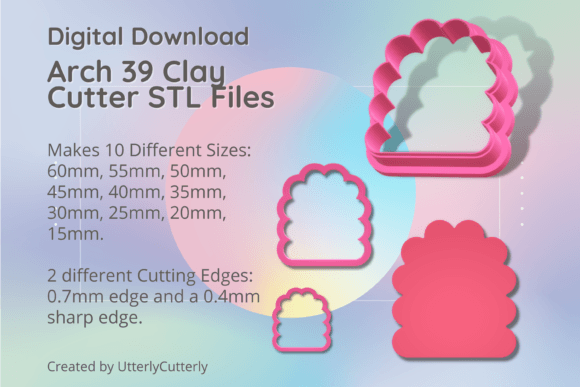
Evaluating the utility of the Arch 39 Clay Cutter - Bubble Arc STL Dig requires a close examination of its dimensional parameters. The pack includes ten incremental sizes measured from the longest ends: 60mm, 55mm, 50mm, 45mm, 40mm, 35mm, 30mm, 25mm, 20mm, and 15mm. This graduated sizing allows makers to create cohesive sets or scale designs for different end products, such as matching earring and pendant sets. The consistency in sizing increments facilitates predictable scaling when integrating these shapes into broader design collections.
The file set offers two distinct cutter types, each engineered for specific material behaviors and finish requirements:
- Standard Wall: Features a 0.7mm wall thickness with a 3mm thick base and a total height of 12mm. This profile prioritizes structural rigidity and durability during the printing process.
- Sharp Edge (SE): Abbreviated as SE in the file names, this variant includes a 1mm support wall tapering to a 0.4mm cutting edge. It shares the same 3mm base and 12mm height but is optimized for cleaner cuts in softer materials.
For users planning to utilize embossing features within the design, note that embossing lines are set at 10.5mm tall. Consequently, effective use of these details requires working with clay slabs thicker than 1.5mm to prevent the cutter from bottoming out before the impression is fully transferred. This specification is a critical constraint for makers who typically work with very thin veneers or delicate sheets.
Applications and Material Compatibility
The primary value proposition of this digital bundle lies in its cross-disciplinary application. For jewelry makers, the bubble arc shape offers an organic, fluid geometry suitable for modern earrings, barrettes, and pendants. The availability of smaller sizes (15mm–30mm) specifically addresses the needs of earring designers who require lightweight, detailed components. Larger sizes (40mm–60mm) transition effectively into statement pieces or hair accessories.
Beyond polymer clay, the STL files are compatible with food-safe manufacturing workflows, provided the user employs appropriate food-safe filaments and post-processing sealing methods. The smooth curves of the bubble arc design minimize crevices where dough or fondant might stick, making them practical for cookie and cake decoration. However, users must distinguish between cutters intended solely for clay and those designated for food use, as cross-contamination risks exist even with thorough cleaning. The dual-purpose nature of the Arch 39 Clay Cutter - Bubble Arc STL Dig makes it a high-utility asset for makers operating in both craft and culinary niches.
Benefits of Digital STL Acquisition
Choosing a digital download over a physical cutter introduces several logistical and economic advantages. Immediate access eliminates shipping wait times, allowing for rapid prototyping and iteration. If a specific size is missing from a physical inventory, the digital format permits on-demand production within hours. Furthermore, the cost-per-unit decreases significantly over time; once the initial file purchase is made, replacement cutters or additional sizes cost only the price of filament and electricity.
Customization is another inherent benefit. While the Arch 39 pack provides fixed dimensions, owning the STL files allows technically proficient users to modify the Z-height or reinforce specific stress points in slicer software before printing. This adaptability ensures the tool can be tailored to specific clay brands or personal ergonomic preferences, a flexibility rarely available with mass-produced metal or plastic cutters.
Tradeoffs and Practical Considerations
Despite the advantages, prospective buyers must weigh specific tradeoffs associated with 3D printed tools. Layer lines are an unavoidable characteristic of FDM printing. Without significant post-processing, such as sanding or epoxy coating, these lines may transfer texture onto the clay surface. Makers seeking glass-smooth finishes directly from the cutter may find the standard 0.7mm wall insufficient without additional finishing steps. The Sharp Edge (SE) variant mitigates some cutting friction, but it remains a plastic edge rather than metal, requiring more frequent replacement as the blade dulls over extended use.
Print failure rates also represent a variable cost. Thin walls and sharp tapers can be challenging for printers with poor cooling or calibration. Users without dialed-in retraction settings or adequate part cooling fans may experience stringing or warping, particularly with the 0.4mm cutting edge of the SE files. Evaluating your printer’s current performance envelope is necessary before purchasing; this product assumes a baseline level of 3D printing competency.
Determining Fit and Alternative Options
The Arch 39 Clay Cutter - Bubble Arc STL Dig is likely a strong fit for makers who already own a reliable 3D printer and possess intermediate slicing knowledge. It serves those who value geometric consistency across multiple scales and require immediate access to new shapes. It is particularly well-suited for production artists who consume cutters as wear items and prefer to manufacture replacements in-house rather than maintaining inventory of fragile physical goods.
Conversely, alternatives may be worth considering for beginners without 3D printing infrastructure. The upfront investment in hardware, combined with the learning curve of print troubleshooting, often exceeds the cost of purchasing individual physical cutters for low-volume hobbyists. Additionally, makers requiring surgical precision or working exclusively with extremely hard clays may find brass or stainless steel cutters superior. Metal edges maintain sharpness indefinitely and do not introduce layer line textures, offering a finish quality that plastic cannot replicate without extensive labor.
Ultimately, the decision hinges on balancing convenience against finish quality. For versatile, scalable, and customizable shaping tools, this digital bundle offers substantial utility. For pristine, heirloom-quality impressions without post-processing, traditional manufacturing methods remain the benchmark. Assess your volume, equipment reliability, and finish standards to determine if the digital fabrication route supports your creative objectives.