Clay Cutter STL File Decadent Donut 1: Digital Specifications and Usage Evaluation
The Clay Cutter STL File Decadent Donut 1 is a digital asset designed for polymer clay artists, bakers, and crafters who utilize 3D printing technology to create custom tools. Unlike physical cutters shipped via mail, this product is a downloadable bundle containing stereolithography (STL) files optimized for fused deposition modeling (FDM) or resin 3D printers. The collection focuses on an elegant, decadent donut silhouette intended for diverse applications ranging from jewelry making to culinary decoration. Evaluating this digital file requires understanding its technical specifications, printability, and suitability for specific crafting workflows compared to traditional manufacturing methods.
Technical Specifications and Design Variants
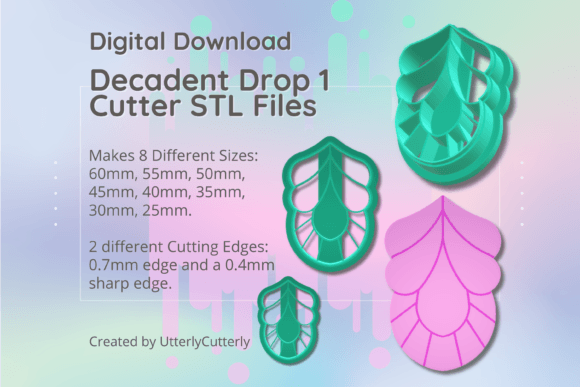
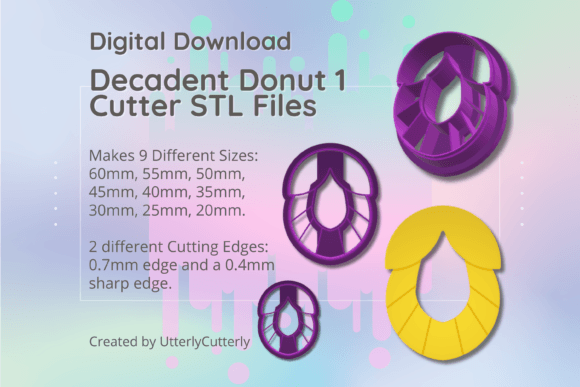
When assessing the utility of the Clay Cutter STL File Decadent Donut 1, the primary consideration is the inclusion of two distinct cutting edge profiles within the same bundle. This duality addresses different material viscosities and finishing requirements. Understanding the difference between these variants is essential for selecting the correct file before printing.
- Standard Edge: This variant features a 0.7mm wall thickness with a 3mm thick base and a total height of 12mm. The wider wall provides structural rigidity during the printing process and offers durability when pressing into denser materials like cookie dough or fondant. It is generally more forgiving for beginners or those using printers with standard nozzle configurations.
- Sharp Edge (SE): Abbreviated as SE in the file names, this version includes a 1mm support wall leading to a precise 0.4mm cutting edge. Like the standard version, it maintains a 3mm base and 12mm height. The sharper profile is engineered specifically for polymer clay jewelry, where clean cuts reduce post-processing sanding time and preserve fine details in earrings and pendants.
The bundle encompasses nine discrete sizes measured from the longest ends: 60mm, 55mm, 50mm, 45mm, 40mm, 35mm, 30mm, 25mm, and 20mm. This graduated sizing allows creators to produce cohesive sets, such as nesting decorations or matched earring and pendant combinations, without needing to source multiple individual products.
Application Versatility and Material Compatibility
The design intent behind the Clay Cutter STL File Decadent Donut 1 spans both artistic and culinary domains, though performance varies by medium. For jewelry makers, the 20mm to 40mm range is typically most relevant for earrings and barrettes, while the larger 50mm to 60mm sizes suit statement pendants or holiday ornaments. Users working with polymer clay should note that if embossing lines are present in the specific design iteration, they are modeled at 10.5mm tall. Consequently, successful impression transfer requires conditioning clay to a thickness greater than 1.5mm to prevent bottoming out or distorting the cutter base.
In culinary contexts, the standard 0.7mm edge is preferable. Polymer clay cutters often lack the food-safe certification required for commercial kitchens, but home bakers frequently use printed tools for fondant, gum paste, and cookie dough. The 12mm height accommodates rolled doughs effectively, though users must verify their filament material is food-safe and non-toxic if intending edible applications. The digital nature of the file means users assume responsibility for material safety based on their chosen printer filament and post-processing sealants.
Evaluating Digital Downloads vs. Physical Cutters
Choosing the Clay Cutter STL File Decadent Donut 1 over a physical alternative involves weighing immediate access against production effort. Digital files eliminate shipping wait times and international customs delays, providing instant utility for time-sensitive projects like Christmas gift preparation. Furthermore, the economic model differs significantly; once purchased, the marginal cost of producing additional cutters is limited to filament and electricity, whereas physical cutters incur per-unit costs.
However, this convenience introduces tradeoffs. Ownership requires access to a calibrated 3D printer and basic slicing software knowledge. Print failures, layer adhesion issues, or nozzle clogs can render the file temporarily unusable until hardware issues are resolved. Physical cutters arrive ready-to-use with consistent manufacturing tolerances, whereas printed results depend entirely on user calibration. Additionally, STL files cannot be returned or exchanged in the traditional sense once downloaded, making pre-purchase evaluation of the design style critical.
Printability and Slicing Considerations
The stated design goal of being "easily printed" suggests the geometry avoids extreme overhangs or unsupported bridges. Nevertheless, users should evaluate their printer’s capabilities regarding thin walls. The Sharp Edge variant’s 0.4mm cutting tip may require tuning flow rates or utilizing a smaller nozzle diameter (0.2mm or 0.3mm) to achieve dimensional accuracy. Printing with a standard 0.4mm nozzle may result in a blunt edge that mimics the standard variant rather than achieving the intended sharpness.
Bed adhesion is another practical factor. With a 3mm base across all sizes, the footprint is generally sufficient for adhesion, but the smallest 20mm cutter has less surface area contact. Users may need to employ brims or adjust first-layer squish settings for the smaller sizes to prevent warping or detachment during printing. Orienting the cutter with the cutting edge facing up is standard practice to avoid support structures inside the hollow body, preserving the smooth finish necessary for clean clay release.
Determining Fit for Specific Crafting Goals
The Clay Cutter STL File Decadent Donut 1 represents a strong fit for makers who value customization and already possess 3D printing infrastructure. It is particularly advantageous for sellers on platforms like Etsy who need to scale production without increasing inventory overhead, or for hobbyists experimenting with size variations before committing to a final design. The weekly release schedule mentioned by the provider also suggests long-term value for users seeking to build a cohesive tool library over time.
Conversely, alternatives may be worth considering for those without printing equipment or those requiring certified food-safe tools for commercial sale. Metal cutters offer superior longevity and heat conductivity for baking, while professionally molded plastic cutters guarantee consistency without calibration. If the donut aesthetic is secondary to functional reliability in a high-volume production environment, industrial-grade physical tools may outweigh the flexibility of this digital asset. Ultimately, the decision hinges on whether the user prioritizes the adaptability of digital fabrication or the guaranteed performance of manufactured goods.