Window 9 Arch Clay Cutter STL Digital File
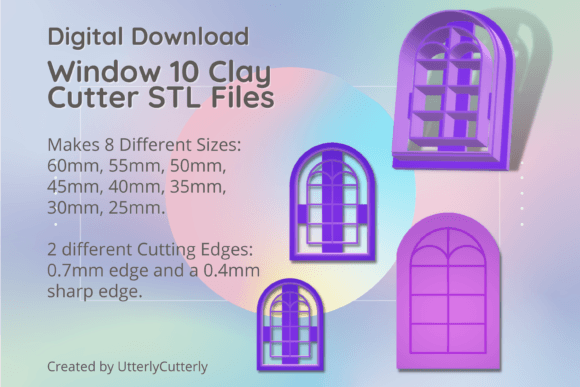
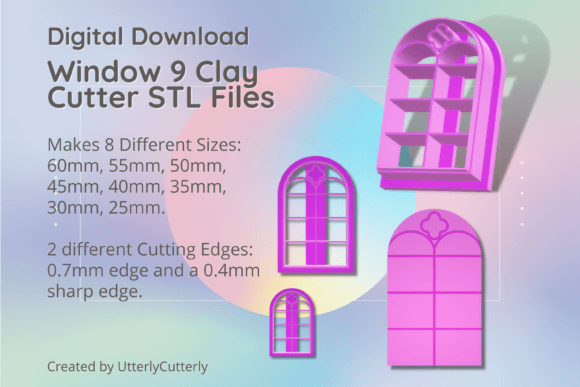
For makers utilizing 3D printing technology to create polymer clay jewelry, ceramic components, or culinary decorations, the precision of the cutting tool defines the quality of the final product. The Window 9 Clay Cutter - Arch Digital File provides a specialized solution for creators who require consistent, elegant arch shapes without the wait times associated with physical shipping. This digital download bundle includes STL files optimized for immediate printing, allowing you to produce eight distinct sizes ranging from 25mm to 60mm. By transitioning to digital fabrication, artisans gain control over their production timeline and can iterate on designs instantly.
This specific arch design is engineered to address common pain points in handmade manufacturing, such as uneven edges or structural weakness during the demolding process. Whether you are producing lightweight resin earrings, intricate pendants, hair barrettes, or fondant accents for cakes, having access to professionally modeled geometry ensures that every piece maintains uniform dimensions. The ability to print these tools on demand means your workshop inventory scales precisely with your current project needs, eliminating clutter and reducing overhead costs associated with purchasing pre-made plastic cutters.
Selecting the Right Edge Profile for Your Material
A critical advantage of this digital file pack is the inclusion of two distinct cutter variations designed for different material behaviors. Understanding when to use each profile prevents wasted clay and reduces post-processing time. The files are categorized clearly to help you make informed decisions before hitting print.
- Standard 0.7mm Wall: This version features a 0.7mm wall thickness with a robust 3mm base and a total height of 12mm. It is the recommended choice for softer materials like cookie dough, fondant, or marzipan where durability is necessary to prevent the cutter from warping under pressure. In polymer clay work, this edge is ideal for thicker slabs or when you intend to texture the surface immediately after cutting, as the slightly wider rim provides better stability against the clay bed.
- Sharp Edge (SE): Abbreviated as SE in the file names, this variant utilizes a 1mm support wall tapering down to a precise 0.4mm cutting edge. Like the standard version, it maintains a 3mm thick base and 12mm height for ergonomic handling. This profile is essential for detailed jewelry making where clean lines minimize the need for sanding. The sharper angle slices through conditioned polymer clay and metal clay with less resistance, preserving delicate details and reducing the risk of dragging or distorting the arch shape.
Choosing the correct file prevents frustration. Using a sharp edge on stiff cookie dough may cause the blade to dull or chip, while using the standard 0.7mm wall on thin earring clay might leave a ridge that requires excessive finishing. Having both options in one digital bundle allows you to adapt your toolset to the specific medium you are working with that day.
Optimizing Print Settings for Durability and Precision
The performance of the Window 9 Clay Cutter - Arch Digital File depends heavily on your slicer settings and printer calibration. While the STL files are designed for easy printing, achieving the intended 0.4mm or 0.7mm tolerances requires attention to detail. For FDM printers, a 0.4mm nozzle is generally sufficient, but ensure your flow rate is calibrated to avoid over-extrusion which can close up thin walls. Resin printers offer superior accuracy for the Sharp Edge variants, capturing the fine taper without layer lines that might transfer to soft clay.
Orientation matters significantly for these arch shapes. Printing the cutter upright with the cutting edge facing the build plate usually yields the best results, provided you use adequate supports that do not fuse to the blade itself. Alternatively, printing flat on the base eliminates support removal risks entirely, though layer lines will run horizontally across the cutting face. If choosing the flat method, consider sanding the cutting edge lightly with high-grit paper to restore smoothness. Always verify the dimensional accuracy of your first test print; if the 25mm size measures 24mm due to shrinkage, adjust your scaling factor globally to ensure all eight sizes remain proportionally correct.
Versatile Sizing for Cohesive Collection Building
Consistency is key when building a product line or a themed collection. This bundle offers a graduated sizing scale measured from the longest ends: 60mm, 55mm, 50mm, 45mm, 40mm, 35mm, 30mm, and 25mm. This incremental progression allows creators to design nested sets or complementary pieces that share the same architectural language. For example, a jeweler might use the 60mm and 55mm sizes for statement necklace pendants, the 40mm and 35mm sizes for standard drop earrings, and the 25mm size for delicate studs or ring blanks.
For culinary professionals and bakers, this range facilitates tiered decoration. A wedding cake might feature large 60mm fondant arches on the bottom tier, graduating down to 25mm accents on the top tier. Because these are digital files, you can print multiples of the most-used sizes to speed up production during busy seasons without needing to reorder. The standardized measurements also integrate seamlessly with other STL files in our growing library, enabling you to curate custom cutter combos that maintain visual harmony across diverse projects.
Working with Embossing Lines and Clay Thickness
Certain variations within this digital pack include integrated embossing lines to add internal detail to the arch shape. Users must note a specific technical constraint regarding these textured versions: the embossing lines stand 10.5mm tall relative to the base. To function correctly and leave a clear impression without cutting through the material, you must roll your clay slab to a minimum thickness of 1.5mm. Attempting to use these embossed cutters on thinner sheets will result in the clay being pierced or the design failing to register clearly.
This specification highlights the importance of reading technical documentation before production. For standard cutting without embossing, thinner clays are permissible, but the embossed functionality transforms the tool into a dual-purpose device. When working at the required 1.5mm+ thickness, ensure even pressure is applied across the entire 12mm height of the cutter to guarantee the embossing contacts the clay uniformly. This feature saves an additional step in the workflow by combining shaping and detailing into a single motion, streamlining the creation of complex barrettes or decorative tiles.
Digital Ownership and Production Efficiency
It is important to reiterate that the Window 9 Clay Cutter - Arch Digital File is not a physical item. Access is granted immediately upon payment confirmation, providing instant utility for urgent deadlines. This model supports sustainable manufacturing practices by eliminating plastic waste from unsold inventory and carbon emissions from logistics. You retain the master files indefinitely, meaning a broken cutter is no longer a financial loss but merely a few minutes of reprint time.
For small business owners and educators, this digital format simplifies inventory management and lesson planning. There is no risk of suppliers discontinuing a specific size or changing mold specifications unexpectedly. You own the exact geometry needed for your brand identity or curriculum. Furthermore, as new STL files are added to the store weekly, your existing library remains compatible, allowing for continuous expansion of your creative capabilities without compatibility issues. This ecosystem approach ensures that your investment in digital tooling compounds in value over time, supporting long-term growth and creative exploration.