Wiggle Triangle 1 Clay Cutter - Mid Cent: Strategic Digital Assets for Makers
The Wiggle Triangle 1 Clay Cutter - Mid Cent represents more than a simple geometric shape; it is a strategic digital asset designed to streamline production and enhance aesthetic consistency for modern makers. As a digital download STL file bundle, this toolset bridges the gap between mid-century modern design sensibilities and contemporary fabrication technology. For entrepreneurs, hobbyists, and small business owners operating in the polymer clay, jewelry, or culinary decoration spaces, acquiring this specific cutter set is an exercise in operational efficiency. It eliminates the uncertainty of sourcing physical tools while providing immediate access to a versatile design language that resonates with current market trends.
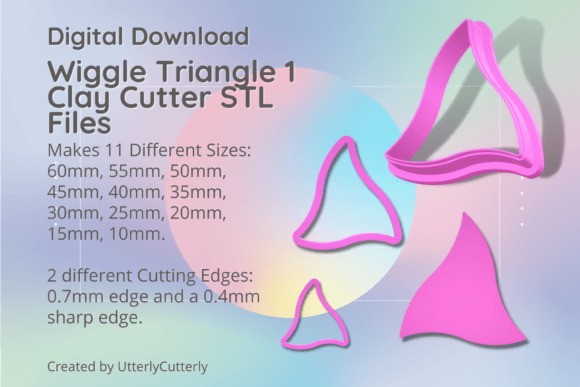
Strategically, the value of this digital pack lies in its comprehensive sizing and dual-edge engineering. Rather than purchasing individual physical cutters that may arrive dull or inconsistently sized, you gain instant access to eleven precise dimensions ranging from 10mm to 60mm. This granularity allows for intentional product planning. Whether you are curating a cohesive earring collection, designing tiered fondant decorations, or prototyping pendant sizes, having the entire spectrum available ensures your creative decisions are driven by design intent rather than inventory limitations. The mid-century wiggle triangle aesthetic offers a timeless yet playful silhouette that performs well across diverse niches, making it a high-utility addition to any maker’s digital library.
Technical Specifications and Production Planning
To leverage the Wiggle Triangle 1 Clay Cutter - Mid Cent effectively, one must understand the technical distinctions between the two included cutter types. This bundle is not monolithic; it offers specialized tools for different stages of production and material requirements. Making informed decisions about which file to print requires aligning the cutter specifications with your end-use goals.
- Standard Edge (0.7mm Wall): This version features a 0.7mm wall thickness, a 3mm thick base, and a 12mm height. Strategically, this is your workhorse cutter. The thicker wall provides rigidity during the cutting process, reducing distortion when working with firmer clays or dense cookie doughs. The 3mm base offers a comfortable grip surface, which is essential for repetitive production runs where hand fatigue can compromise quality. Use this variation for structural components, larger pendants, or any application where durability of the tool itself is paramount.
- Sharp Edge (SE): Abbreviated as SE in the file names, this variant includes a 1mm support wall tapering to a precise 0.4mm cutting edge. Like the standard version, it maintains a 3mm base and 12mm height. This specification is engineered for detail-oriented work. The thinner cutting edge reduces drag and displacement, resulting in cleaner lines on delicate polymer clay slabs or soft fondant. Select this file when surface finish and edge definition take precedence over tool longevity. It is particularly valuable for creating professional-grade jewelry where post-processing time must be minimized.
Both cutter types share a consistent 12mm height, ensuring compatibility with standard clay conditioning workflows. However, users must note that any embossing lines within these designs are 10.5mm tall. This dimensional constraint dictates that you should only use these cutters with materials thicker than 1.5mm to prevent bottoming out or incomplete impressions. Understanding these parameters before printing prevents wasted filament and failed production batches.
Sizing Strategy for Product Cohesion
The inclusion of eleven distinct sizes—from 60mm down to 10mm in 5mm increments—is a deliberate feature that supports scalable product development. Many makers struggle with collections that feel disjointed because they lack proportional relationships between pieces. The Wiggle Triangle 1 Clay Cutter - Mid Cent solves this by providing a mathematically consistent size progression.
When planning a new product line, consider how these sizes interact. A 60mm cutter might serve as the statement piece in a necklace set, while the 40mm and 25mm versions create complementary stud earrings. The 15mm and 10mm sizes open opportunities for micro-jewelry, charm bracelets, or intricate cake borders that require precision without sacrificing the core design identity. By utilizing the full range, you create a visual ecosystem where every item feels related yet distinct. This cohesion strengthens brand recognition and encourages customers to purchase multiple items as part of a curated set rather than isolated units.
Furthermore, measuring from the longest ends ensures accurate scaling across your workflow. When documenting your products for e-commerce listings or social media content, referencing these standardized measurements builds trust with buyers who need to visualize scale. Consistency in sizing also simplifies packaging and photography setups, as you can predict spatial requirements based on known cutter dimensions.
Optimizing Your 3D Printing Workflow
Since this is a digital STL file bundle, the quality of your final tool depends entirely on your printing strategy. These files are designed to be easily printed, but achieving optimal results requires thoughtful machine setup. Treat the printing process as part of your manufacturing quality control.
- Material Selection: Use PLA or PETG for food-safe applications if certified, or standard PLA for clay-only use. Avoid flexible filaments unless specifically testing for unique release properties, as rigidity is generally preferred for clean cuts.
- Layer Height Considerations: For the Sharp Edge (SE) variants, use a finer layer height (0.12mm or lower) to preserve the integrity of the 0.4mm tip. Standard edge versions can tolerate 0.2mm layers, balancing speed with adequate strength.
- Orientation and Supports: Print cutters vertically with the cutting edge facing up to avoid support marks on the functional surface. If your printer struggles with bridging on the sharp edge variant, utilize tree supports or adjust cooling fan settings to maintain dimensional accuracy.
- Post-Processing: Inspect the first layer carefully. Any imperfections on the cutting edge will transfer directly to your clay. Light sanding with high-grit paper can refine the edge, but prevention through proper bed leveling and nozzle calibration is always superior to correction.
By treating your 3D printer as a precision manufacturing instrument rather than a hobbyist toy, you ensure that every Wiggle Triangle 1 Clay Cutter - Mid Cent produced meets professional standards. This mindset shift transforms digital files into reliable business assets.
Risk Mitigation and Intentional Usage
While digital cutter bundles offer immense flexibility, relying on them without clear goals introduces specific risks. The primary danger is overproduction without validation. Having access to eleven sizes does not mean you should manufacture inventory in all eleven immediately. Instead, adopt a lean approach: print and test one or two sizes first to validate market interest and material compatibility before committing to full-scale production.
Another consideration is intellectual property and licensing. Always verify the terms associated with the STL download. While you own the physical objects you create, the digital file usage rights may have restrictions regarding resale or redistribution of modified designs. Respecting these boundaries protects your business from legal complications and supports the sustainability of the designer ecosystem.
Additionally, recognize the limitations of FDM printing compared to industrial injection molding. Even well-tuned prints may exhibit layer lines that require management. Test your cutters with your specific clay body or dough recipe before accepting large orders. Some materials stick more readily to 3D printed surfaces; identifying this early allows you to implement release agents or adjust your printing parameters proactively. Intentional usage means anticipating friction points and solving them before they impact customer experience.
Expanding Your Design Ecosystem
The Wiggle Triangle 1 Clay Cutter - Mid Cent is positioned as part of a broader design system. With new STL files released weekly, there is a strategic advantage to viewing this purchase as an entry point rather than a standalone acquisition. Curating custom cutter combos becomes significantly easier when you source from a single designer with a consistent aesthetic philosophy.
Consider how mid-century modern elements pair with other geometric or organic shapes in the store’s catalog. Building a library of compatible cutters reduces cognitive load during the design phase and creates natural cross-selling opportunities in your shop. When customers recognize a unified design language across your products, perceived value increases. Regularly reviewing new releases allows you to stay ahead of trends while maintaining the operational familiarity of established file structures.
Ultimately, this digital bundle serves creators who value autonomy and precision. It removes supply chain dependencies, enables rapid iteration, and provides the technical foundation necessary for professional output. By approaching the Wiggle Triangle 1 Clay Cutter - Mid Cent with strategic intent—understanding its specifications, leveraging its size range, and integrating it into a broader creative system—you transform a simple shape into a catalyst for sustainable growth and distinctive craftsmanship.