Clay Cutter STL File Triangle Diamond 1: Versatile Digital Designs for Makers
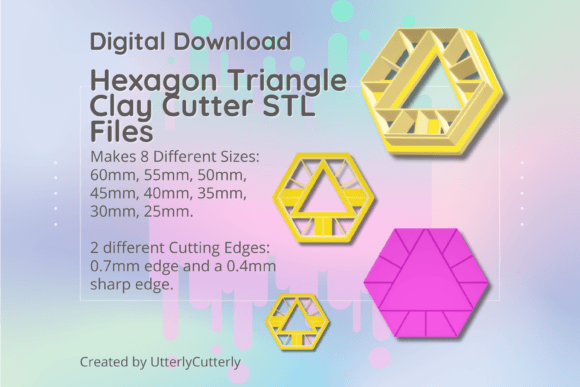
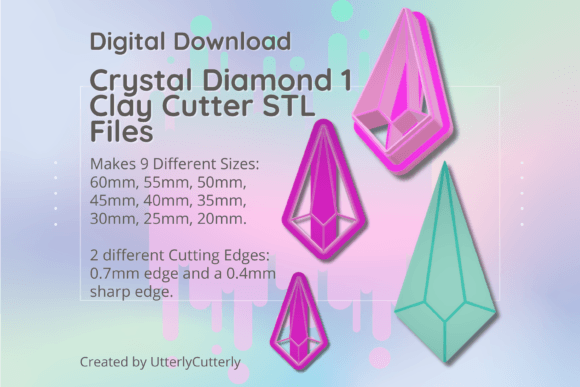
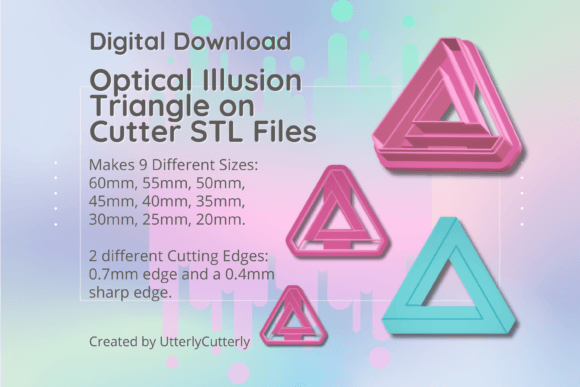
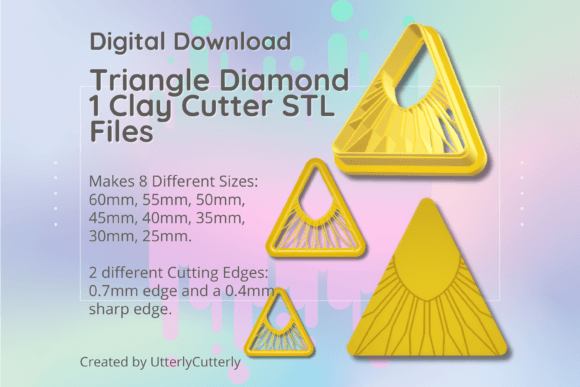
The Clay Cutter STL File Triangle Diamond 1 represents a shift toward customizable, on-demand manufacturing for small business owners and hobbyists. Rather than waiting for shipping or settling for mass-produced shapes, this digital download bundle empowers you to print exactly what you need, when you need it. This specific pack focuses on the timeless triangle diamond geometry, offering eight distinct sizes ranging from 25mm to 60mm. Whether you are scaling up production for an upcoming craft fair or prototyping a new jewelry line at your kitchen table, having immediate access to these files streamlines the creative process significantly.
Choosing the Right Edge for Your Medium
One of the most practical aspects of this STL bundle is the inclusion of two distinct cutting edge profiles. Understanding the difference between them is crucial for achieving professional results across various materials. The files are categorized into standard walls and Sharp Edge (SE) variants, each serving a specific purpose in your workflow.
The Standard 0.7mm Wall
The standard cutter features a 0.7mm wall thickness with a 3mm thick base and a 12mm height. This robust design is the workhorse of polymer clay crafting. The slightly thicker wall provides structural integrity during the cutting motion, preventing the cutter from flexing or warping when pressing through firmer clays like Sculpey III or Kato Polyclay. This version is ideal for:
- General Jewelry Making: Creating consistent earring and pendant blanks where edge precision is important but extreme sharpness is not required.
- Cookie Decorating: Cutting through rolled fondant or cookie dough without dragging. The 0.7mm edge seals the dough slightly as it cuts, helping cookies maintain their shape during baking.
- Durability: For makers who use their cutters frequently, this wall thickness withstands repeated washing and handling better than ultra-thin alternatives.
The Sharp Edge (SE) Variant
Abbreviated as SE in the file names, this variant features a 1mm support wall tapering down to a precise 0.4mm cutting edge. While the base remains 3mm thick for grip and stability, the business end is significantly finer. This profile excels in scenarios requiring minimal cleanup post-cutting:
- Delicate Polymer Clay: When working with soft or translucent clays that tend to distort under pressure, the SE blade slices cleanly rather than pushing the material aside.
- Intricate Detail Work: If your triangle diamond design includes internal negative space or fine points, the sharper edge preserves these details far better than the standard wall.
- Fondant & Gum Paste: For cake decorators, the SE version creates razor-sharp edges on sugar paste, eliminating the need to trim ragged borders with a scalpel after cutting.
Sizing Strategy for Product Cohesion
Having eight sizes in a single bundle allows for sophisticated product curation that would be cost-prohibitive with physical cutters. The sizes included—25mm, 30mm, 35mm, 40mm, 45mm, 50mm, 55mm, and 60mm—are measured from the longest ends of the triangle diamond. This graduated sizing opens up several real-world applications beyond simple shape replication.
Jewelry Collections: You can create cohesive "nesting" sets where earrings, pendants, and charms share the same geometric language but differ in scale. A 60mm statement necklace pendant pairs beautifully with 35mm drop earrings and 25mm stud accents. Having all sizes available digitally means you can test proportions instantly without committing to inventory.
Bakery and Confectionery: For bakers, size variation is essential for tiered presentations. Use the 60mm and 55mm cutters for main cake toppers or large cookies, while the 30mm and 25mm sizes are perfect for cupcake toppers, petit fours, or garnish elements. The ability to print food-safe PLA or PETG cutters in exact dimensions ensures your edible decorations look professionally planned rather than improvised.
Hair Accessories: Barrettes and hair clips often require specific sizing based on the mechanism used. A French barrette might accommodate a 50mm triangle diamond, while a mini claw clip works best with the 30mm version. Testing fit with printed prototypes saves wasted clay and hardware.
Practical Considerations for Printing and Use
While the Clay Cutter STL File Triangle Diamond 1 is designed for easy printing, success depends on matching your printer settings to the intended application. Since this is a digital download, the quality of your final tool relies entirely on your slicing parameters and material choice.
Embossing Line Compatibility
If you plan to utilize the embossing lines included in certain designs, note that they stand 10.5mm tall. This is a critical specification often overlooked until mid-project. These lines are engineered to work optimally with clay conditioned to at least 1.5mm thickness. Rolling your clay thinner than this threshold will result in the embossing feature bottoming out or tearing through the material. Always measure your clay slab with calipers before attempting detailed impressions. For cookie work, ensure your dough is rolled consistently; uneven rolling leads to partial impressions that can look unintentional.
Material Selection for Food Safety
When using these STL files for cookies or fondant, remember that FDM 3D printing inherently creates layer lines that can harbor bacteria. Even if you print with food-safe filament, the printed part itself is not automatically food-safe. Best practice involves sealing printed cutters with a food-grade epoxy resin or using them exclusively with parchment paper barriers. Alternatively, reserve specific printers and nozzles solely for food-related prints to avoid cross-contamination from previous non-food projects. Many professional bakers use these STL files to create master molds in silicone instead of using the printed cutter directly on food, which solves both safety and durability concerns.
Print Orientation and Support
For optimal strength, print these cutters upright with the cutting edge facing the build plate. This aligns layer lines vertically along the wall rather than horizontally across the cutting edge, resulting in a smoother finish and stronger structure. The 3mm thick base is designed to provide adequate adhesion without supports, but if you experience bed adhesion issues with the smaller 25mm or 30mm sizes, consider adding a brim. Avoid tree supports inside the cutter cavity, as removal is difficult and can damage the precise cutting edge. Instead, rely on the self-supporting geometry of the triangle diamond shape, which typically handles overhangs well within the 12mm height constraint.
Expanding Your Creative Toolkit
This bundle serves as a foundation rather than a complete solution. The triangle diamond geometry is intentionally versatile, designed to complement other shapes in our growing library. Because new STL files are added weekly, you can continuously expand your collection to match seasonal trends or client requests without storage constraints. Digital files also enable rapid iteration; if a particular size doesn’t work for a project, you can scale it slightly in your slicer or request a custom modification much faster than sourcing a new physical tool.
Remember that this is strictly a digital product. After payment, you gain immediate access to download the files, allowing you to begin production within minutes rather than days. This immediacy transforms how you approach deadlines, sample creation, and custom orders. Whether you are a jeweler seeking consistency, a baker needing precision, or a crafter exploring new forms, the Clay Cutter STL File Triangle Diamond 1 provides the technical specifications and variety necessary to execute your vision with confidence.