Clay Cutter STL File - Hexagon Flower 1: Strategic Digital Assets for Makers
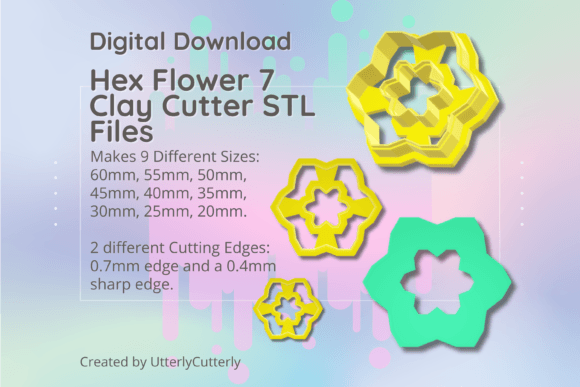
For modern makers, artisans, and small business owners, the transition from manual prototyping to digital fabrication is a pivotal moment in operational scaling. The Clay Cutter STL File - Hexagon Flower 1 represents more than just a geometric shape; it is a strategic digital asset that bridges the gap between creative design and consistent manufacturing. This specific bundle offers a versatile hexagon flower design optimized for polymer clay, cookie dough, fondant, and other molding mediums. By utilizing high-quality STL files, creators can bypass the inconsistencies of hand-cutting and establish a repeatable production standard essential for branding and customer satisfaction.
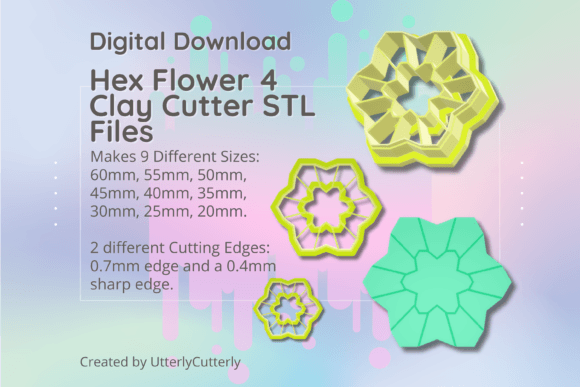
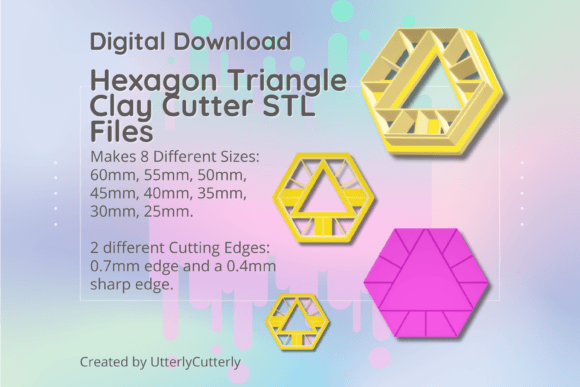
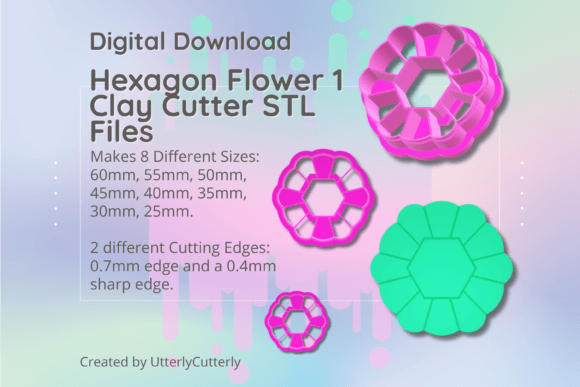
This digital download package is engineered for versatility and precision. It includes eight distinct sizes ranging from 25mm to 60mm, allowing for curated product lines that cater to different market segments. Whether you are designing delicate stud earrings, statement pendants, hair barrettes, or uniform baked goods, having immediate access to scaled variations streamlines the planning phase. The inclusion of two distinct cutting edge profiles further enhances this utility, providing options for both structural durability and fine detail work. Understanding how to leverage these technical specifications is key to maximizing return on investment for your 3D printing setup.
Technical Specifications and Production Planning
Successful integration of digital cutters into a workflow requires a clear understanding of the file architecture. The Clay Cutter STL File - Hexagon Flower 1 bundle provides two primary cutter types, each serving a specific function in the production cycle. Recognizing when to deploy each type prevents material waste and reduces post-processing time.
- Standard Wall (0.7mm): This cutter features a 0.7mm wall thickness with a 3mm thick base and a total height of 12mm. It is strategically best suited for general-purpose cutting where durability is paramount. The thicker wall resists deformation during the pressing motion, making it ideal for stiffer clays or dense cookie doughs. This version ensures longevity of the printed tool and maintains shape integrity over hundreds of uses.
- Sharp Edge (SE): Abbreviated as SE in the file set, this variant utilizes a 1mm support wall tapering to a precise 0.4mm cutting edge. Like the standard version, it has a 3mm base and 12mm height. This profile is designed for clean, crisp cuts in softer materials like conditioned polymer clay or fondant. The sharper edge reduces drag and tearing, resulting in products that require minimal sanding or trimming before finishing.
The size gradient included in this pack—60mm, 55mm, 50mm, 45mm, 40mm, 35mm, 30mm, and 25mm—is measured from the longest ends of the hexagon flower geometry. This standardized measurement system allows makers to plan inventory and packaging dimensions accurately before printing. When curating custom combos with other STL files from our weekly releases, this consistent sizing logic ensures that new designs integrate seamlessly into existing product collections without requiring recalibration of assembly jigs or storage solutions.
Strategic Application Across Product Lines
Versatility is a core component of sustainable maker businesses. The hexagon flower geometry is inherently modular, making the Clay Cutter STL File - Hexagon Flower 1 applicable across diverse revenue streams. However, intentional application requires matching the tool to the medium's physical properties.
Jewelry and Wearable Art
For earring and pendant production, consistency is the primary metric of quality. Customers expect symmetry, especially when purchasing sets. Using the 25mm to 40mm range allows for the creation of lightweight yet substantial pieces. The Sharp Edge (SE) files are particularly valuable here, as they produce clean boundaries that reduce the labor intensity of sanding. For barrettes and hair accessories, the larger 50mm to 60mm sizes provide adequate surface area for adhesive bonding and structural support. The hexagonal tiling nature of the flower design also enables makers to create interlocking patterns or mosaic-style jewelry by combining multiple sizes in a single piece.
Culinary and Confectionery Applications
In the culinary space, visual appeal drives social media engagement and sales. The 0.7mm standard wall cutter is recommended for cookies and fondant due to its rigidity. Food-safe materials must be used when printing these tools, and the robust wall structure facilitates easier cleaning and sanitization. The hexagon flower shape photographs exceptionally well, offering a balance of organic curves and geometric precision that stands out in flat-lay photography. For fondant decorations, the smaller sizes serve as elegant accents on cakes, while the larger sizes can define the silhouette of themed treats.
Optimizing Print Settings for Functional Tools
A digital file is only as effective as the physical object produced from it. To ensure the Clay Cutter STL File - Hexagon Flower 1 performs as intended, print parameters must be adjusted based on the selected cutter type. Treating all STL files with identical settings is a common operational error that leads to premature tool failure or poor cutting performance.
- Material Selection: Use PLA+ or PETG for jewelry cutters to balance stiffness with slight flexibility. For food-related applications, strictly adhere to certified food-safe filaments and consider coating the final print with a food-grade epoxy if long-term hygiene is required.
- Layer Height and Orientation: Print vertically with the cutting edge facing the build plate to maximize resolution at the business end. A layer height of 0.12mm or lower is recommended for the Sharp Edge variants to preserve the 0.4mm tip definition. Standard wall versions can be printed at 0.16mm to 0.2mm for faster turnaround without sacrificing functionality.
- Wall Count and Infill: Prioritize perimeter strength over infill. Set wall counts to match or exceed the designed wall thickness (e.g., 3-4 walls for the SE version). Infill can remain low (15-20%) as the cutting force is distributed through the outer shell and the reinforced 3mm base.
- Brim and Adhesion: Given the relatively small footprint of the 25mm and 30mm cutters, use a brim to prevent warping or detachment during the initial layers. This ensures the base remains perfectly flat, which is critical for achieving uniform clay thickness.
Risk Management and Operational Considerations
While digital fabrication offers immense freedom, relying on STL files without context introduces specific risks. Understanding these limitations protects both the maker’s equipment and the end-user experience.
Embossing Line Constraints: If utilizing embossing details within this or complementary files, note that embossing lines are typically 10.5mm tall. This specification dictates that the clay slab must be thicker than 1.5mm to accommodate the relief without bottoming out. Attempting to use embossing cutters on thin sheets will result in incomplete impressions and potential damage to the cutter’s internal structures. Always gauge clay thickness prior to cutting when working with textured variants.
Digital vs. Physical Expectations: It is vital to communicate clearly with customers and team members that this is a digital download. There is no physical item shipped. Misunderstandings regarding deliverables can harm brand reputation. Furthermore, because printer calibration varies, users should always print a test cutter at the smallest size first to verify dimensional accuracy and edge sharpness before committing to a full production run.
Design Fatigue and Market Saturation: While the hexagon flower is a timeless motif, over-reliance on a single shape can limit brand growth. Use this pack as a foundational element rather than a sole product offering. Combine it with new STL files released weekly to maintain freshness in your catalog. Strategic curation involves mixing evergreen shapes like this hexagon flower with trending seasonal designs to balance reliable revenue with novelty-driven spikes.
Long-Term Value and Workflow Integration
Investing in high-quality STL bundles like the Clay Cutter STL File - Hexagon Flower 1 is an exercise in building proprietary manufacturing infrastructure. Unlike mass-produced metal cutters, digital files allow for on-demand replacement and modification. If a specific size becomes a bestseller, additional units can be printed instantly to scale production capacity without supply chain delays.
To maximize long-term value, organize your digital library systematically. Create folders categorized by size, edge type, and application. Document successful print settings for each file variant to reduce trial-and-error in future sessions. Track which sizes and edge types yield the highest sell-through rates for your specific niche; this data informs future purchasing decisions and helps identify gaps in your current toolset.
Ultimately, the goal is to move beyond viewing STL files as mere downloads and start treating them as integral components of a lean manufacturing process. The hexagon flower design offers a perfect intersection of aesthetic appeal and functional modularity. By approaching its use with strategic intent—selecting the right edge for the material, optimizing print parameters, and respecting technical constraints—makers can transform a simple digital file into a cornerstone of a profitable, scalable creative business. Access to these files grants the autonomy to prototype, produce, and pivot with speed that traditional methods cannot match, positioning your brand for sustained relevance in a competitive marketplace.