Wiggle Rectangle 2 Clay Cutter: Mid-Century Modern STL Files for Polymer Clay and Baking
The intersection of mid-century modern aesthetics and contemporary maker culture has created a sustained demand for geometric, organic shapes in both jewelry design and culinary arts. The Wiggle Rectangle 2 Clay Cutter - Mid Cen digital download addresses this specific niche by providing a comprehensive set of STL files tailored for 3D printing. Unlike generic shape cutters, this bundle focuses on the distinct "wiggle" rectangle silhouette—a form that balances retro nostalgia with modern minimalism. For professionals and serious hobbyists utilizing FDM or resin printers, this asset pack offers a practical solution for producing consistent, high-quality tools without relying on slow shipping or limited commercial inventory.
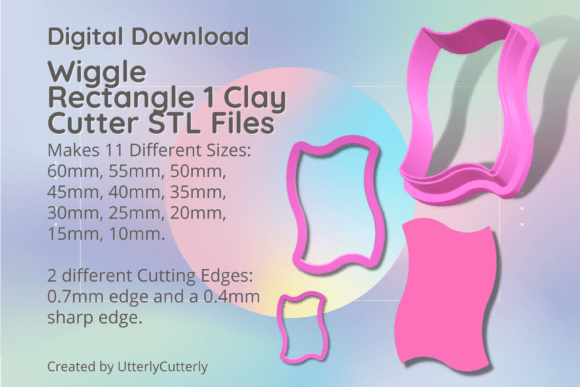
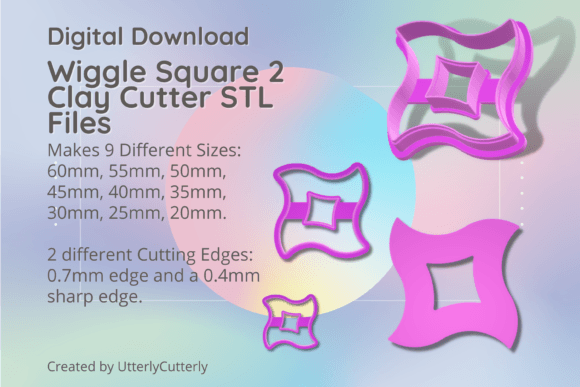
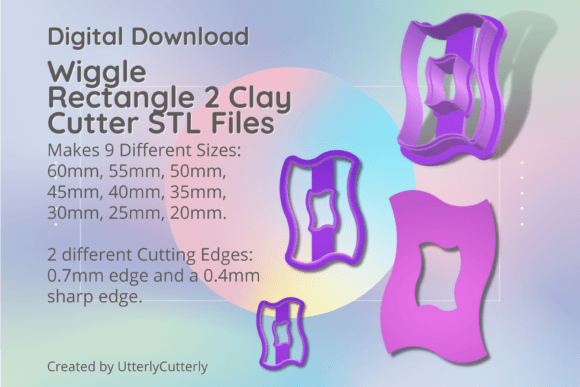
This digital product is not merely a single shape but a curated system designed for versatility. It includes nine distinct sizes ranging from 20mm to 60mm and two specialized cutting edge profiles. This level of variation allows creators to maintain visual consistency across different projects, whether scaling down for delicate stud earrings or scaling up for statement pendants and fondant decorations. By providing the source files rather than a physical object, the Wiggle Rectangle 2 Clay Cutter - Mid Cen empowers users to manufacture tools on-demand, replacing broken cutters instantly or adjusting production volume based on immediate workflow requirements.
Technical Specifications and Printability Analysis
Evaluating an STL file for functional tool creation requires looking beyond the visual preview to the underlying geometry. The Wiggle Rectangle 2 Clay Cutter - Mid Cen is engineered with specific parameters that reflect an understanding of 3D printing limitations and material behavior. The inclusion of two distinct cutter types demonstrates a professional approach to tool design, acknowledging that polymer clay and food products have different release and cutting requirements.
- Standard Edge Profile: Features a 0.7mm wall thickness with a 3mm reinforced base and 12mm height. This specification prioritizes durability and rigidity, making it suitable for firmer clays or repeated use in production environments where thin walls might warp under pressure.
- Sharp Edge (SE) Profile: Abbreviated as SE in the file set, this variant utilizes a 1mm support wall tapering to a 0.4mm cutting edge. With the same 3mm base and 12mm height, this profile is optimized for clean cuts in softer materials, reducing drag and deformation during the slicing process.
- Size Gradation: The set increments in 5mm steps (20, 25, 30, 35, 40, 45, 50, 55, 60mm). Measurements are taken from the longest ends of the wiggle shape, ensuring accurate sizing relative to standard jewelry hardware and baking molds.
From a manufacturing standpoint, these dimensions are well-calibrated for standard 0.4mm nozzles. The 3mm base provides sufficient bed adhesion to prevent warping during printing, while the 12mm height offers adequate clearance for most clay slab thicknesses. Users should note that if embossing lines are present in specific variations, they are set at 10.5mm. This necessitates working with clay slabs thicker than 1.5mm to ensure the embossing registers correctly without piercing through the material. This technical constraint is crucial for planners; attempting to use these cutters on ultra-thin sheets will result in structural failure of the clay piece.
Practical Applications Across Mediums
The utility of the Wiggle Rectangle 2 Clay Cutter - Mid Cen extends across multiple disciplines, though performance varies by application. In polymer clay jewelry fabrication, the mid-century wiggle shape serves as an excellent canvas for techniques like mokume gane, mica shifts, or simple color blocking. The availability of the Sharp Edge (SE) variant is particularly valuable here. When cutting conditioned polymer clay, a sharper edge reduces the "push" effect that often distorts intricate surface designs. The 0.4mm tip slices cleanly, preserving the integrity of the pattern up to the very edge of the form.
For ceramicists working with soft slabs, the Standard Edge profile may be preferable. The slightly thicker 0.7mm wall adds stiffness to the cutter, preventing flex when pressing into leather-hard or soft clay. However, users must account for clay shrinkage during drying and firing. Since the largest cutter is 60mm, those requiring larger ceramic forms may need to scale the STL files in their slicer software, keeping in mind that scaling affects wall thickness proportionally.
In culinary applications, specifically cookies and fondant, the food-safe nature of the printed tool depends entirely on the user's filament choice and post-processing. While the geometry is appropriate for dough, the 12mm height is generous enough to handle thick cookie dough without the handle dragging through the surface. The wiggle rectangle shape translates exceptionally well to mid-century themed events, retro bakeries, or stylized food photography. The consistent sizing ensures uniform baking times, a critical factor for professional bakers who cannot afford uneven results.
Workflow Integration and Customization
One of the primary advantages of acquiring the Wiggle Rectangle 2 Clay Cutter - Mid Cen as a digital asset is integration into existing digital workflows. Makers who already possess a library of STL files can curate custom cutter combos easily. For example, pairing this wiggle rectangle set with complementary arches or circles from the same designer creates a cohesive collection aesthetic that is difficult to achieve when sourcing physical tools from disparate manufacturers. New STL files are added to the store weekly, suggesting an expanding ecosystem rather than a static product line.
Furthermore, digital ownership allows for modification. Advanced users can import these files into CAD software to add handles, modify the embossing depth, or combine multiple shapes into a single multi-cutter tool. This flexibility transforms the purchase from a simple tool acquisition into a foundational design element. For educators and workshop leaders, the ability to print dozens of identical cutters for students at a negligible marginal cost makes this resource significantly more accessible than purchasing individual metal or plastic cutters.
Evaluating Value and Limitations
When assessing the return on investment for the Wiggle Rectangle 2 Clay Cutter - Mid Cen, context matters. For a casual crafter who makes one pair of earrings per year, the time and material cost of printing may outweigh the convenience. However, for small business owners, freelancers, and content creators, the value proposition is strong. The ability to control the means of production eliminates supply chain dependencies. If a best-selling earring design requires a specific cutter size that goes out of stock commercially, the digital file ensures business continuity.
There are realistic limitations to consider. As a digital download, there is no quality assurance on the final physical product; print quality depends entirely on the user’s machine calibration and material selection. A poorly tuned printer will produce layer lines that transfer to the clay, requiring significant sanding or post-processing. Additionally, while the 0.4mm sharp edge is effective, it is inherently more fragile than commercial steel cutters. Dropping a PLA cutter on a hard floor may crack the thin cutting edge, whereas metal would likely survive. Users must treat 3D printed tools as consumable workshop equipment rather than permanent fixtures.
The mid-century modern style, while currently popular, is also subject to trend cycles. Investing heavily in a specific aesthetic carries a degree of market risk. However, the geometric simplicity of the wiggle rectangle gives it a longer shelf life than novelty shapes. It functions as a neutral base that can be adapted through texture and color to fit evolving trends, mitigating the risk of obsolescence.
Recommendations for Implementation
To maximize the effectiveness of the Wiggle Rectangle 2 Clay Cutter - Mid Cen, users should adopt a systematic approach to printing and testing. Start by printing the Sharp Edge variant in a high-resolution setting (0.12mm layer height or lower) to minimize post-processing. Use a brim rather than a raft to ensure the cutting edge remains perfectly flat against the build plate; any deviation in the first layer will result in a jagged cut. For food applications, strictly adhere to food safety protocols, using only certified food-safe filaments and considering a food-safe epoxy coating to seal layer lines where bacteria could accumulate.
Ultimately, this STL bundle represents a functional bridge between digital design and tactile craftsmanship. It serves makers who value precision, autonomy, and aesthetic coherence. By understanding the technical specifications and respecting the material constraints of 3D printed tools, users can integrate the Wiggle Rectangle 2 Clay Cutter - Mid Cen into a sustainable, scalable creative practice. Whether producing inventory for an online shop or developing curriculum for a workshop, this digital asset provides the necessary foundation for consistent, professional-grade results in the mid-century modern idiom.