Unlocking Spring Creativity: A Comprehensive Guide to the Flower 21 Clay Cutter STL Bundle
The intersection of traditional craftsmanship and modern technology has revolutionized how artisans, bakers, and hobbyists approach their creative projects. At the forefront of this evolution is the accessibility of high-quality digital fabrication files. The Flower 21 Clay Cutter - Spring Botanical bundle represents a perfect synthesis of nature-inspired design and precision engineering. This digital download provides creators with the tools necessary to produce professional-grade clay cutters for polymer clay jewelry, ceramic work, or cookie decorating directly from their own 3D printers.
Understanding the nuances of these STL files is essential for maximizing their potential. Unlike generic shapes found in mass-produced plastic sets, this specific collection is engineered with versatility and printability in mind. Whether you are a seasoned maker looking to expand your inventory or a beginner exploring the world of 3D printed crafting tools, grasping the technical specifications and practical applications of this spring botanical set will elevate the quality of your final creations.
The Significance of Digital Craft Tools in Modern Making
In today’s creative landscape, the ability to customize tools is just as important as the artistic skill itself. Digital downloads like the Flower 21 bundle democratize access to specialized equipment. Historically, obtaining specific floral cutter sizes required purchasing expensive metal sets or settling for ill-fitting plastic alternatives. Now, makers can curate custom and unique cutter combos easily by mixing and matching STL files from weekly updated libraries.
This shift toward digital self-sufficiency fits seamlessly into modern small business models and educational environments. For entrepreneurs selling handmade jewelry, owning the source files means zero supply chain delays; if a cutter breaks or a new size trend emerges, it can be printed on demand. In educational settings, these files serve as excellent teaching aids for understanding CAD design, material science, and botany, bridging the gap between STEM learning and artistic expression.
Decoding Technical Specifications: Size and Scale
One of the most common misunderstandings among new users of digital cutter files is assuming that sizing is standardized across all designers. It is crucial to note that for the Flower 21 Spring Botanical pack, cutter size is measured from the longest ends. This distinction ensures accuracy when planning intricate layouts or matching cutters to specific earring hooks and jewelry findings.
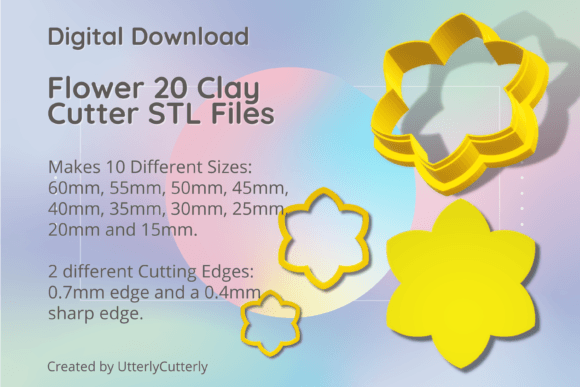
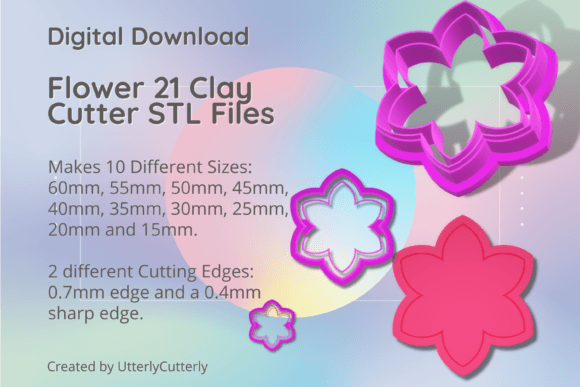
This bundle offers an impressive range of ten distinct sizes, providing granular control over design scaling:
- Large Format: 60mm, 55mm, 50mm (Ideal for statement pieces or cookies)
- Medium Format: 45mm, 40mm, 35mm (Versatile for standard pendants and charms)
- Small Format: 30mm, 25mm, 20mm, 15mm (Perfect for delicate stud earrings and detailing)
Having this spectrum available in a single digital pack allows for cohesive collections. A creator can design a bridal jewelry set featuring the same botanical motif at 60mm for a necklace pendant and 15mm for matching studs, ensuring visual harmony that is difficult to achieve with disparate physical tools.
Understanding Cutting Edge Variations
The true value of this STL bundle lies in its dual-edge engineering. Not all clay requires the same cutting force, and not all 3D printers have identical capabilities. This pack includes two distinct cutter types to address these variables.
- Standard Wall (0.7mm): This version features a 0.7mm wall thickness with a 3mm thick base and a height of 12mm. It is robust, durable, and generally easier to print successfully on entry-level FDM printers. The slightly thicker edge provides structural integrity, making it ideal for firmer clays or repeated use without deformation.
- Sharp Edge (SE): Abbreviated as "SE" in the file names, this variant boasts a 1mm support wall tapering to a precise 0.4mm cutting edge. Like the standard version, it maintains a 3mm thick base and 12mm height. The SE files are designed for creators who prioritize clean, crisp cuts over maximum durability. They require a well-tuned printer but reward the user with reduced clay drag and minimal post-processing sanding.
Embossing Lines and Material Considerations
Many botanical cutters include internal details to add texture and realism to the clay. However, a frequent point of confusion arises regarding embossing line depth versus clay thickness. If the Flower 21 design includes embossing lines, they are engineered to be 10.5mm tall.
Given that the total cutter height is 12mm, this leaves a clearance of only 1.5mm. Therefore, for the embossing detail to register correctly without punching through or distorting the clay, you must work on clay thicker than 1.5mm. Using clay that is too thin will result in the embosser hitting the work surface, potentially damaging both your mat and the printed cutter. Understanding this geometric relationship prevents wasted material and frustration, highlighting why reading technical specs is as vital as the printing process itself.
Practical Applications Across Mediums
While often marketed toward polymer clay artists, the utility of the Flower 21 Spring Botanical STL extends far beyond jewelry making. The food-safe nature of PLA (when used with appropriate precautions) and the variety of sizes make these cutters invaluable in culinary arts.
Jewelry and Accessories: The sharp edge variants excel here, creating clean outlines for translucent clays where jagged edges would ruin the optical clarity. The smaller sizes allow for micro-floral accents that mimic real botanical specimens.
Ceramics and Pottery: The larger 50mm-60mm sizes and the sturdier 0.7mm wall versions are better suited for earthenware and porcelain. These clays are denser and more abrasive; the reinforced walls resist snapping during the pressing motion required for ceramic slabs.
Baking and Confectionery: Spring botanical themes are perennial favorites in cake decorating. The ability to print a fresh cutter for every season ensures hygiene and sharpness that dull metal cutters cannot maintain over years of use.
Best Practices for Digital File Management
Because this is strictly a digital item, proper file management is part of the ownership experience. Upon payment, you gain immediate access to the download. Organizing these files systematically saves time during future creative sessions. We recommend creating folders based on both size and edge type (e.g., "Flower21_SE_30mm" and "Flower21_Std_30mm").
Furthermore, while our cutters are tested before being sold as part of our quality assurance process, individual printer calibration varies. Always print a test slice or a small calibration cube before committing to a full batch of cutters. Layer adhesion is critical for cutter longevity; ensure your nozzle temperature and cooling fan settings are optimized for functional parts rather than decorative models. A cutter that delaminates under pressure is usually a symptom of print settings rather than file defects.
Expanding Your Creative Toolkit
The Flower 21 pack is designed to be interoperable with other designs. As new STL files arrive in our store every week, the ecosystem grows. By mastering the specifications of this spring botanical set, you build a foundational knowledge that applies to future releases. You learn to anticipate which edge type suits your current project, how to adjust clay thickness for embossers, and how to leverage size gradation for professional product lines.
Ultimately, investing in high-quality digital cutter files is an investment in creative autonomy. It removes the barriers between imagination and execution, allowing you to focus less on searching for the right tool and more on bringing your spring botanical visions to life. Whether you are crafting heirloom jewelry or seasonal treats, the precision and versatility of these 3D printable cutters provide the reliable foundation every maker deserves.