Mastering Art Deco Design: A Guide to the Square E & A Clay Cutter STL Bundle
The resurgence of Art Deco aesthetics in modern jewelry making and culinary arts has created a distinct demand for precision tools that capture the geometric elegance of the 1920s. For creators utilizing 3D printing technology, the Clay Cutter STL File Art Deco Square - E and A bundle represents a significant intersection of digital fabrication and traditional craftsmanship. This digital download is not merely a set of shapes; it is a comprehensive toolkit designed to bridge the gap between vintage design sensibilities and contemporary manufacturing capabilities. Whether you are crafting polymer clay earrings, fondant cake decorations, or ceramic pendants, understanding the technical nuances of this STL bundle is essential for achieving professional-grade results.
The Intersection of Digital Fabrication and Vintage Aesthetics
Art Deco is defined by its symmetry, bold geometric patterns, and streamlined forms. Translating these architectural principles into small-scale objects like jewelry or cookies requires exactitude that freehand cutting simply cannot achieve. This is where 3D printed cutters excel. By utilizing an STL file specifically engineered for Art Deco motifs, makers can ensure that every curve and angle adheres to the stylistic integrity of the era.
In the context of modern creative businesses and hobbyist studios, digital downloads like the E and A bundle offer unparalleled flexibility. Unlike mass-produced metal cutters, which are limited to fixed sizes and designs, STL files allow for on-demand production. This fits seamlessly into the workflow of small business owners who need to adapt their product lines quickly based on trends or custom client requests. The ability to print your own tools means your creative output is never bottlenecked by shipping times or supplier stock issues.
Understanding Technical Specifications: Wall Thickness and Edge Types
One of the most critical aspects of working with 3D printed clay cutters is understanding how different edge profiles affect the final material. This specific bundle provides two distinct cutter types, each serving a unique purpose in the creation process. Recognizing when to use each type is fundamental to mastering this toolset.
The Standard 0.7mm Wall Profile
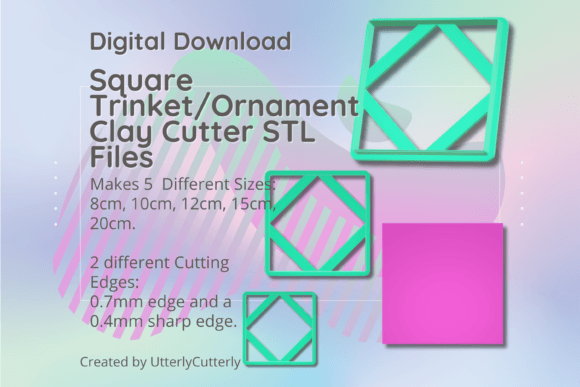
The first variation features a 0.7mm wall thickness with a 3mm thick base and a total height of 12mm. This profile is the workhorse of polymer clay and cookie decoration. The 0.7mm edge is thin enough to slice cleanly through conditioned clay or rolled fondant without dragging, yet thick enough to maintain structural rigidity during the printing process. This balance prevents the cutter from warping under pressure, ensuring that your Art Deco squares remain perfectly geometric rather than becoming distorted ovals.
The Sharp Edge (SE) Profile
For advanced users requiring extreme definition, the bundle includes the Sharp Edge (SE) variant. Abbreviated as SE in the file names, this cutter features a 1mm support wall that tapers down to a precise 0.4mm cutting edge. Like the standard version, it maintains a 3mm base and 12mm height for ergonomic handling. The SE profile is specifically intended for detailed work where minimal cleanup is desired post-cutting. However, users should note that the thinner 0.4mm tip requires careful slicing settings in your 3D printer software to prevent layer separation. This edge is ideal for softer clays and delicate fondant work where a crisp silhouette is paramount.
Versatility Through Size Gradation
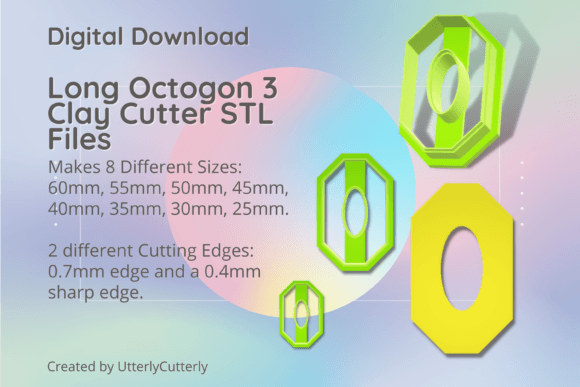
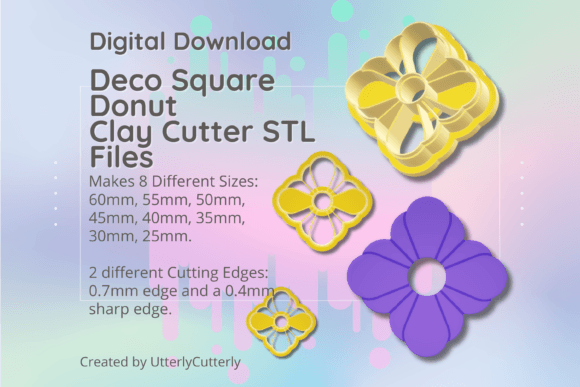
A common misconception among beginners is that a single cutter size is sufficient for a project. In reality, professional curation relies on scale variation. The E and A bundle addresses this by providing eight distinct sizes: 60mm, 55mm, 50mm, 45mm, 40mm, 35mm, 30mm, and 25mm.
It is important to clarify that these measurements refer to the longest ends of the cutter. This gradation allows makers to create cohesive collections rather than isolated pieces. For example, a jewelry maker might use the 60mm and 55mm sizes for statement pendant necklaces, while utilizing the 30mm and 25mm versions for matching stud earrings. In culinary applications, the larger sizes serve as main cookie cuts, while the smaller sizes function as intricate fondant overlays or garnish elements. Having access to this full spectrum within a single digital pack eliminates the guesswork of scaling models manually, which can often distort the aspect ratio of complex Art Deco geometry.
Navigating Embossing Lines and Material Depth
Beyond simple outline cutting, many Art Deco designs rely on surface texture to convey luxury and depth. If your chosen STL files within this bundle include embossing lines, there is a crucial technical parameter to observe: embossing lines are 10.5mm tall.
This specification dictates your material preparation. To achieve a clean impression without the embosser bottoming out or failing to register, you must work with clay that is thicker than 1.5mm. Since the total cutter height is 12mm, a 10.5mm embossing feature leaves exactly 1.5mm of clearance. Using clay thinner than this threshold will result in incomplete textures or potential damage to the printed layers. This relationship between tool geometry and material volume is a prime example of why reading technical specifications is just as important as the artistic vision itself. Always measure your clay slab with calipers before attempting detailed embossing to ensure compatibility with the tool's dimensions.
Optimizing Your 3D Printing Workflow
Because this is a digital download and not a physical item, the quality of your final cutter depends entirely on your printing setup. These files are designed to be easily printed, but "easy" assumes correct configuration. Here are best practices for getting the most out of the E and A bundle:
- Orientation: Print cutters flat on the build plate with the cutting edge facing up. This ensures the smoothest possible finish on the functional edge and maximizes bed adhesion via the 3mm base.
- Nozzle Selection: While a standard 0.4mm nozzle can print the SE (Sharp Edge) files, using a 0.2mm or 0.25mm nozzle will significantly improve the fidelity of the 0.4mm cutting tip and any internal Art Deco detailing.
- Material Choice: PLA is generally sufficient for polymer clay and fondant. However, if you plan to use these cutters with ceramic clay or abrasive materials, consider PETG or ABS for increased durability and heat resistance.
- Cooling: Ensure part cooling fans are at 100% after the first few layers. The thin walls of the SE cutters require rapid cooling to prevent heat creep and dimensional inaccuracy.
Expanding Your Creative Ecosystem
The Art Deco Square E and A bundle is designed as part of a broader ecosystem. The description notes that new STL files are added to the store weekly, encouraging makers to curate custom and unique cutter combos. This modular approach to tool acquisition mirrors the modular nature of Art Deco design itself, where individual geometric units combine to form complex wholes.
By building a library of compatible STL files, you reduce waste and increase efficiency. Instead of purchasing disparate tools that may not share a consistent design language, you can assemble a suite of cutters that work harmoniously together. This is particularly relevant for educators and workshop leaders who need reliable, standardized tools for students. Digital files can be distributed instantly, ensuring every participant has access to the exact same equipment, leveling the playing field and allowing instruction to focus on technique rather than troubleshooting mismatched tools.
Clarifying the Digital Nature of the Product
Finally, it is vital to reiterate that this is not a physical item. Upon payment, you receive immediate access to download the STL files. There is no shipping, no waiting, and no physical inventory to manage. This distinction is important for international makers who wish to avoid customs delays or high shipping costs associated with importing plastic goods. It also places the responsibility of quality control on the user. Understanding your printer’s tolerances, maintaining your machine, and selecting appropriate filaments are now part of the creative process.
Embracing digital fabrication tools like the Clay Cutter STL File Art Deco Square bundle empowers creators to take full ownership of their production pipeline. From the precise 0.4mm sharp edges to the thoughtful 8-size gradation, every aspect of this file set is engineered to facilitate beautiful, historically informed creation. Whether you are baking for a Gatsby-themed event or designing a new line of geometric jewelry, these files provide the technical foundation necessary to bring your Art Deco visions to life with confidence and consistency.