Mastering Mid-Century Design: A Guide to the Long Octagon 3 Clay Cutter STL Bundle
In the evolving world of polymer clay jewelry and artisanal cookie decorating, the distinction between handmade charm and professional precision often lies in the tools used. While freehand shaping has its place, achieving consistent geometric aesthetics requires specialized equipment. The Long Octagon 3 Clay Cutter - Mid Century digital download represents a significant shift in how creators approach geometric design. This STL file bundle is not merely a set of shapes; it is a comprehensive system designed for modern makers who utilize 3D printing technology to curate unique, versatile, and professionally finished products.
Understanding this digital asset requires looking beyond the simple act of cutting clay. It involves grasping the intersection of mid-century modern design principles, additive manufacturing technology, and practical craft application. Whether you are a seasoned jeweler looking to streamline production or a hobbyist exploring new forms, this guide explores the purpose, technical specifications, and creative potential of this specific cutter collection.
The Intersection of Retro Aesthetics and Modern Technology
Mid-century modern design is characterized by clean lines, organic curves, and geometric simplicity. The elongated octagon is a quintessential shape within this movement, offering a softer alternative to the rectangle while maintaining more structure than an oval. However, sourcing physical cutters for niche vintage shapes can be difficult and expensive. This is where digital fabrication changes the landscape.
By offering these designs as STL files, the barrier to entry for high-quality tooling is removed. Makers no longer need to wait for shipping or settle for generic sizes. Instead, they gain immediate access to a library of shapes that can be printed on demand. This model fits seamlessly into modern creative workflows, allowing for rapid prototyping and customization. If a specific earring design requires a 45mm cutter rather than a standard 50mm, the maker can simply print the exact size needed within hours. This agility is essential for small businesses responding to trends and individual artists refining their signature style.
Understanding Technical Specifications and Printability
A common misunderstanding among those new to 3D printed clay cutters is assuming all STL files are created equal. Poorly designed files can result in fragile tools, rough edges, or printing failures. The Long Octagon 3 bundle is engineered specifically for ease of printing and functional durability. Understanding the technical breakdown is crucial for getting the best results from your 3D printer.
Versatility Through Size Gradation
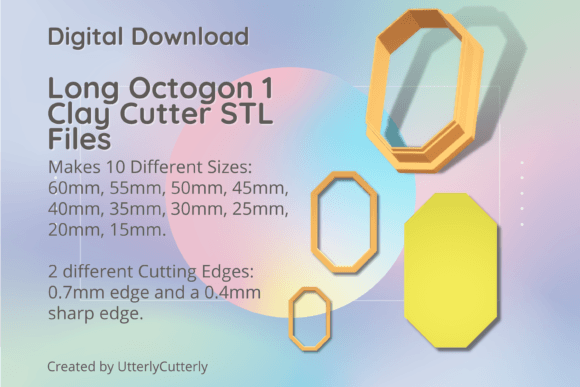
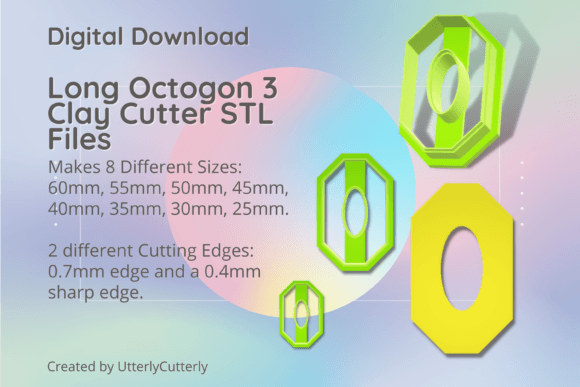
This pack includes eight distinct sizes, measured from the longest ends of the octagon. The range covers:
- 60mm: Ideal for statement pendants, large coasters, or substantial cookies.
- 55mm & 50mm: Perfect for standard earrings and medium-sized decorative elements.
- 45mm & 40mm: Versatile mid-range sizes suitable for brooches and charms.
- 35mm, 30mm, & 25mm: Designed for delicate stud earrings, ring tops, and intricate detailing.
This graduated sizing allows creators to build cohesive collections. For example, a jewelry line might feature the same long octagon shape scaled across different pieces, creating visual harmony that is difficult to achieve with mismatched tools.
Dual Edge Profiles for Different Applications
The inclusion of two distinct cutting edge types addresses the diverse needs of clay artists. Recognizing that one edge profile does not suit every material or technique is a hallmark of thoughtful tool design.
- The Standard Edge (0.7mm Wall): This version features a 0.7mm wall thickness, a 3mm thick base, and a 12mm height. It is robust and durable, making it excellent for general-purpose cutting in polymer clay, ceramic clay, and fondant. The thicker wall provides structural integrity during the pressing motion, reducing the risk of deformation.
- The Sharp Edge (SE): Abbreviated as "SE" in the file names, this variant boasts a 1mm support wall tapering to a precise 0.4mm cutting edge. With the same 3mm base and 12mm height, this cutter is engineered for clean, crisp cuts with minimal drag. It is particularly valuable for detailed work where reducing post-cutting cleanup is a priority. The sharper profile slices through conditioned polymer clay effortlessly, preserving the integrity of the shape's perimeter.
Practical Application and Embossing Considerations
Beyond simple outlining, these cutters offer functionality for surface design. Users should note that if there are any embossing lines integrated into the specific variation of the file, they stand at 10.5mm tall. This specification is critical for success.
To utilize embossing features effectively, your clay slab must be thicker than 1.5mm. Attempting to emboss clay that is too thin will result in tearing or bottoming out, ruining both the piece and potentially clogging the cutter. This technical constraint highlights the importance of understanding your materials alongside your tools. When working correctly, however, the 10.5mm depth ensures a pronounced impression that remains visible even after sanding and finishing.
Curating Custom Collections with Digital Assets
One of the most significant advantages of adopting STL-based tooling is the ability to curate custom combinations. Physical cutter sets are often sold in fixed assortments that may include sizes or shapes you never use. With digital downloads, you acquire only what serves your current project.
Furthermore, new STL files are added to the store weekly. This continuous expansion means your toolkit can evolve alongside your artistic growth. You might start with the Long Octagon 3 Mid Century set and later integrate complementary arches, fluted circles, or textured stamps from future releases. Because all files are tested before sale, you can mix and match with confidence, knowing that the tolerances and print settings remain consistent across the brand’s ecosystem.
Important Distinctions: Digital vs. Physical
It is vital to clarify that this is not a physical item. Upon payment, you receive access to download the digital files immediately. No plastic cutter will arrive in the mail. This distinction is fundamental to the value proposition:
- Instant Access: No shipping delays allow for spontaneous creativity.
- Unlimited Reproduction: If a cutter breaks or wears out, you can simply reprint it at the cost of filament.
- Customization: Advanced users can modify the STL files in slicing software to adjust infill, perimeters, or even scale slightly for specific material shrinkage rates.
For those without a 3D printer, local maker spaces, libraries, and online printing services offer affordable ways to produce these tools. The democratization of manufacturing means that owning the digital file is effectively the same as owning the tool itself.
Best Practices for Printing and Usage
To maximize the lifespan and performance of your Long Octagon cutters, consider the following educational tips for 3D printing and maintenance:
- Material Choice: PLA is standard, but PETG offers better heat resistance if you plan to use the cutters with warm clay or wash them in hotter water. Resin printers can achieve incredible detail for the SE (Sharp Edge) variants but require thorough post-curing to ensure food safety if used for cookies.
- Layer Height: Printing at 0.12mm or lower layer heights produces smoother cutting edges, which translates to cleaner clay cuts. While 0.2mm is faster, the layer lines may transfer texture to the clay edge.
- Cleaning: Always clean cutters immediately after use. Polymer clay residue can harden in crevices. Use a soft brush and mild soap; avoid abrasive scrubbers that could dull the SE cutting edge.
- Storage: Keep printed cutters away from direct sunlight and high heat to prevent warping, especially with PLA. Storing them flat helps maintain the 3mm base integrity.
Conclusion
The Long Octagon 3 Clay Cutter - Mid Century STL bundle exemplifies how digital fabrication empowers modern artisans. By combining nostalgic design sensibilities with precise, user-centric engineering, it bridges the gap between retro inspiration and contemporary creation. Whether you are producing jewelry, cookies, or mixed media art, understanding the nuances of edge profiles, sizing, and material requirements transforms a simple download into a powerful extension of your creative capability. As you explore this and future additions to the STL library, remember that the true value lies not just in the file itself, but in the endless possibilities it unlocks for your unique artistic voice.