Evaluating the Clay Cutter STL File Circle Knot 1 - Ear for Digital Fabrication
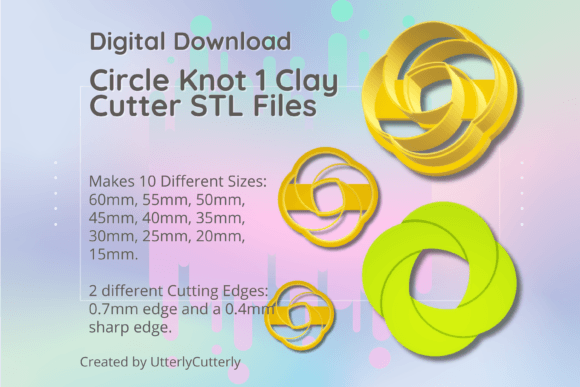
The Clay Cutter STL File Circle Knot 1 - Ear represents a specific category of digital fabrication assets designed for creators who own 3D printers. Rather than purchasing a physical tool, users acquire a set of stereolithography files that allow for the on-demand production of circle knot-shaped cutters. This digital download includes ten distinct sizes ranging from 15mm to 60mm and offers two unique cutting edge profiles. For makers involved in polymer clay jewelry, fondant decoration, or cookie design, understanding the technical specifications and practical applications of this STL bundle is essential for determining if it aligns with current production needs.
Technical Specifications and Printability
When evaluating any cutter STL file, the primary consideration is whether the geometry is optimized for Fused Deposition Modeling (FDM) printing. The Clay Cutter STL File Circle Knot 1 - Ear is engineered with specific wall thicknesses and base dimensions to balance durability with cutting precision. The bundle provides two distinct cutter types to accommodate different materials and finish requirements.
The first option features a standard wall configuration with a 0.7mm wall thickness, a 3mm thick base, and a total height of 12mm. This profile is generally more robust and easier to print successfully on standard nozzle sizes without clogging. The second option, abbreviated as SE (Sharp Edge) in the file names, utilizes a 1mm support wall tapering to a 0.4mm cutting edge. While the SE variant requires more precise printer calibration, it yields cleaner cuts in softer materials. Both variants share a 3mm reinforced base and 12mm height, providing adequate rigidity to prevent flexing during use.
Users should note that embossing lines within the design are set at 10.5mm tall. This specification dictates that the material being cut must be thicker than 1.5mm to avoid bottoming out or damaging the printed layer adhesion. This constraint is critical for bakers working with thin doughs or jewelers using delicate clay sheets, as insufficient material depth can result in incomplete impressions or structural failure of the cutter.
Versatility Across Mediums
The inclusion of ten incremental sizes—60mm, 55mm, 50mm, 45mm, 40mm, 35mm, 30mm, 25mm, 20mm, and 15mm—makes this STL pack highly versatile. Size gradation is a significant factor in product evaluation because it allows creators to maintain design consistency across different project scales. A single size often limits utility; however, this range supports everything from miniature earring components to larger pendant bases or barrettes.
For culinary applications, the larger diameters (40mm–60mm) are suitable for cookies and fondant decorations where structural integrity is paramount. Conversely, the smaller sizes (15mm–30mm) cater specifically to the jewelry market, where weight and proportion are critical for wearable comfort. The ability to print multiple sizes from a single digital purchase eliminates the need to source individual physical cutters, streamlining inventory management for small business owners.
Benefits of Digital Acquisition vs. Physical Tools
Choosing a digital STL file over a pre-manufactured cutter offers distinct advantages regarding customization and cost-efficiency. Once the Clay Cutter STL File Circle Knot 1 - Ear is downloaded, the user retains permanent access to the design. If a cutter breaks during production or wears down after extensive use, a replacement can be fabricated immediately without shipping delays. This autonomy is particularly valuable for production potters or bakers operating on tight deadlines.
Furthermore, digital files allow for parametric adjustments. Advanced users can modify the STL in slicing software to alter infill density, adjust the number of perimeter walls for added strength, or even scale the model slightly to account for filament shrinkage rates. Physical cutters do not offer this level of adaptability. The economic benefit is also notable; the cost per unit decreases significantly when producing cutters in-house, especially when utilizing the full range of ten sizes included in the bundle.
Tradeoffs and Practical Considerations
Despite the advantages, relying on STL files introduces variables that physical products do not. The quality of the final cutter is entirely dependent on the user’s 3D printer capabilities and calibration. Printing a 0.4mm sharp edge requires a well-tuned machine with proper cooling and flow rate adjustments. Users with entry-level printers or those unwilling to perform fine-tuning may find the SE variant frustrating to produce reliably.
Material selection also plays a role in performance. Standard PLA is common but may deform if used with warm clay or washed in hot water. PETG or ABS offers better thermal resistance but can be more challenging to print with high detail. Additionally, layer lines are an inherent characteristic of FDM printing. Without post-processing such as sanding or acetone smoothing, these lines may transfer texture to the clay or fondant. Makers seeking a glass-smooth finish directly from the printer may need to manage expectations or invest time in finishing techniques.
Another consideration is the non-refundable nature of digital goods. Unlike physical items that can be returned if they fail to meet expectations, STL files generally cannot be returned once downloaded. Prospective buyers must carefully review the technical specifications, particularly the minimum clay thickness requirement relative to the embossing line height, before purchasing.
Determining Fit for Specific Workflows
The Clay Cutter STL File Circle Knot 1 - Ear is a strong fit for makers who already possess a reliable 3D printer and have experience printing functional parts. It is ideal for businesses that require scalable tooling or frequently update their design offerings based on trends. The weekly release schedule of new STL files mentioned by the provider suggests an ecosystem approach, making this pack a logical starting point for those intending to build a comprehensive library of compatible cutter designs.
However, alternatives may be worth considering for specific scenarios. Creators without 3D printing infrastructure, or those who lack the time to manage printer maintenance and failures, may find purchasing physical cutters more economical when factoring in labor and material waste. Similarly, professionals requiring food-safe certification may prefer injection-molded stainless steel or food-grade silicone cutters, as verifying the food safety of 3D printed plastics involves complex compliance considerations that STL files alone cannot guarantee.
Ultimately, the decision hinges on the balance between convenience and control. This digital bundle offers maximum flexibility and long-term value for technically proficient makers. By understanding the dimensional constraints, printing requirements, and medium compatibility outlined above, users can make an informed choice about integrating the Circle Knot 1 design into their creative workflow.