Clay Cutter STL File Flower Hexagon 7: Technical Specifications and Creative Applications for Digital Fabrication
The intersection of digital fabrication and traditional handcrafting has revolutionized how artisans approach jewelry making, culinary arts, and mixed media design. At the forefront of this convergence is the Clay Cutter STL File Flower Hexagon 7, a specialized digital asset designed for precision manufacturing via 3D printing. Unlike generic geometric tools, this specific file bundle offers a curated combination of floral aesthetics within a hexagonal framework, providing makers with a versatile instrument for creating consistent, professional-grade components. Understanding the technical nuances of this STL file is essential for maximizing print quality and ensuring the final physical tool performs optimally across various mediums, from polymer clay to fondant.
Dual-Edge Engineering and Print Optimization
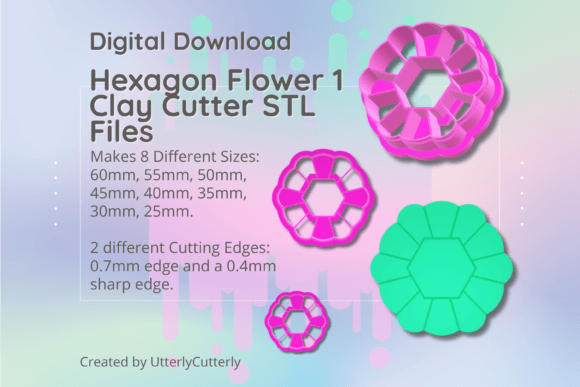
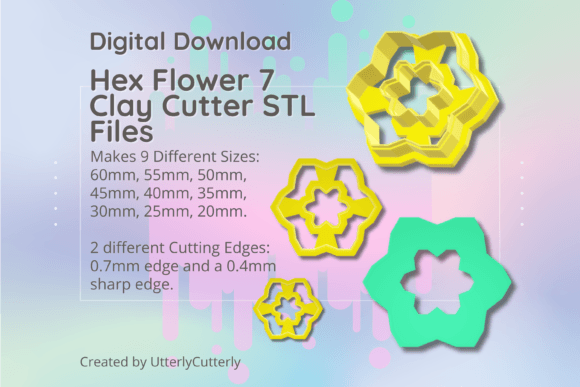
A defining characteristic of the Flower Hexagon 7 digital download is the inclusion of two distinct cutting edge profiles within the same package. This duality addresses the varying needs of different materials and user preferences regarding post-processing. When preparing these files for fabrication, selecting the correct variant is as important as the printing parameters themselves.
The Standard 0.7mm Wall Configuration
The first cutter type features a robust 0.7mm wall thickness. This specification is engineered for durability and ease of handling. The thicker wall provides structural integrity during the printing process, reducing the likelihood of layer shifting or nozzle clogging on standard FDM printers. For users working with denser clays or requiring a tool that can withstand repeated mechanical stress, this version offers superior longevity. The 0.7mm edge leaves a slightly rounded impression on softer materials, which can be desirable for organic-looking jewelry pieces where razor-sharp definition is secondary to form.
The Sharp Edge (SE) Variant
For applications demanding high-definition detail, the Sharp Edge variant—abbreviated as SE in the file nomenclature—is indispensable. This design utilizes a 1mm support wall that tapers down to a precise 0.4mm cutting edge. This geometry mimics the performance of commercial metal cutters, allowing for clean penetration through polymer clay, ceramic paste, and cookie dough without dragging or deformation. The 0.4mm tip requires careful calibration during slicing; however, the resulting cut minimizes the need for manual trimming and sanding. Makers focusing on intricate earring components or detailed fondant work typically prefer the SE files for their ability to maintain crisp internal corners within the flower-hexagon hybrid shape.
Dimensional Versatility Across Nine Sizes
Scalability is a critical factor in production workflows. The Flower Hexagon 7 bundle eliminates the limitation of fixed sizing by providing nine discrete dimensions. This range allows creators to establish visual hierarchies within their designs or adapt to specific project constraints without compromising the geometric integrity of the shape.
- 60mm and 55mm: Ideal for statement pendants, large barrettes, or cookie decorations where the floral motif serves as the primary focal point.
- 50mm, 45mm, and 40mm: The mid-range sizes offer the most versatility, functioning well for standard earrings, brooches, and medium-sized pastry accents.
- 35mm, 30mm, 25mm, and 20mm: These smaller iterations are essential for charm-making, ring tops, and delicate garnish work where subtlety is required.
It is important to note that all measurements refer to the longest ends of the cutter. This standardized measurement protocol ensures predictable results when integrating these tools into existing workflows. Having access to this full spectrum enables makers to curate custom combinations, pairing multiple sizes to create layered effects or graduated sets. Furthermore, because these are digital assets, users can mix and match sizes from this pack with other STL files in their library to develop unique product lines that cannot be replicated with off-the-shelf physical tools.
Cross-Medium Utility: From Jewelry to Culinary Arts
While primarily marketed toward the polymer clay community, the utility of the Flower Hexagon 7 STL extends significantly into culinary and educational sectors. The food-safe nature of properly printed PLA or PETG makes these cutters valuable for bakers and confectioners. The hexagonal geometry provides a modern alternative to traditional round or square cookie cutters, while the internal floral detail adds sophistication to fondant overlays and gum paste flowers.
In the realm of jewelry design, the hexagon-flower hybrid solves a common aesthetic challenge: balancing geometric structure with organic softness. Pure hexagons can appear industrial, while pure flowers may lack architectural stability. This combined silhouette offers a stable base for resin inlays, mica powder application, and surface texturing. Educators and workshop leaders also find value in this digital bundle; the ability to print replacement tools on demand ensures that classes are never halted by broken equipment, and the variety of sizes accommodates students with different motor skill levels or project scopes.
Critical Considerations for Embossing and Material Thickness
Users must pay close attention to the vertical tolerances specified in the file documentation to avoid functional failures. If the specific variation includes embossing lines, these features are set at a height of 10.5mm. This dimension dictates the minimum material thickness required for successful operation.
To achieve a clear impression without the embosser bottoming out or tearing through the medium, the clay or dough must be conditioned to a thickness greater than 1.5mm. Working with material thinner than this threshold risks damaging both the workpiece and the printed tool. This specification highlights the importance of using slab rollers or adjustable rolling pins when preparing material for use with these specific STL files. Additionally, the overall height of the cutter body is 12mm with a 3mm thick base across both edge variants. This substantial base provides a comfortable grip surface and prevents flexing during use, but it also means users should ensure their printer’s Z-axis calibration is accurate to maintain the intended 12mm total height.
Digital Asset Management and Printing Best Practices
Acquiring the Clay Cutter STL File Flower Hexagon 7 is a transaction for intellectual property and digital data, not a physical shipment. Immediate access post-payment allows for rapid prototyping and iteration. However, the quality of the final tool is entirely dependent on the user's printing environment and slicer settings.
For optimal results with the Sharp Edge (SE) files, a hardened steel nozzle is recommended over brass to prevent wear from abrasive clay residues over time. Layer heights between 0.12mm and 0.16mm strike the best balance between print speed and edge resolution. Infill density does not need to exceed 20% given the small cross-sectional area, but perimeter walls should be maximized to ensure the cutting edge remains solid. Users should also consider orientation; printing the cutter upright with the cutting edge facing the build plate usually yields the sharpest result, provided adequate brim or raft adhesion is used to prevent warping.
Because new STL files are added to the ecosystem weekly, maintaining an organized digital library is crucial. Naming conventions should be preserved to distinguish between the 0.7mm and SE variants, as well as the specific size increments. This organizational discipline streamlines the workflow, allowing professionals and hobbyists alike to locate the exact tool needed for a specific commission or creative experiment without trial and error.
Strategic Advantages of On-Demand Tool Fabrication
The shift toward digital cutter libraries represents a fundamental change in maker economics. Traditional metal cutters require expensive custom tooling for each new design, limiting innovation and variety. By utilizing STL files like the Flower Hexagon 7, creators decouple design complexity from manufacturing cost. A complex floral-hexagonal hybrid costs no more to produce digitally than a simple circle.
This accessibility democratizes high-end design capabilities. Small business owners can test market response to new shapes without significant upfront investment. Researchers and educators can modify or scale designs to suit specific experimental parameters. Hobbyists gain access to professional-grade tooling previously reserved for mass manufacturers. Ultimately, the value of this digital bundle lies not just in the geometry it produces, but in the autonomy it grants the user to define their own toolkit, adapt to changing trends instantly, and maintain complete control over the quality and specification of their creative instruments.