Clay Cutter STL File - Thin Moon 2 - Ear: Integrating Digital Assets into Creative Production
The Clay Cutter STL File - Thin Moon 2 - Ear represents a specific node in the digital fabrication workflow for polymer clay artists, bakers, and jewelry designers. Rather than viewing this asset as a standalone product, it is more effective to understand it as a modular component within a broader production system. This digital download provides the geometric data necessary to manufacture physical tools that bridge the gap between digital design and tangible creation. For professionals and hobbyists managing a creative business or personal studio practice, integrating this STL file requires attention to technical specifications, printer calibration, and material compatibility to ensure consistent results across different mediums.
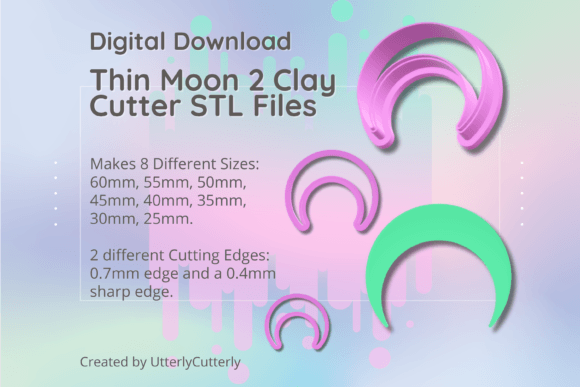
In the context of modern maker workflows, owning the source file for your tools offers distinct advantages over purchasing pre-made cutters. It allows for on-demand manufacturing, inventory reduction, and immediate access to new designs. The Thin Moon 2 bundle specifically addresses the need for versatility by including eight distinct sizes and two specialized cutting edge profiles. This variability ensures that the tool remains relevant whether you are prototyping a delicate earring pair or scaling up for fondant decoration on a tiered cake. Understanding how to leverage these variations is key to maximizing the return on your digital asset library.
Technical Specifications and Printer Calibration
Successful implementation of the Clay Cutter STL File - Thin Moon 2 - Ear begins before the print job starts. The files are engineered with specific tolerances that require a well-calibrated 3D printer. Because these tools interact directly with soft materials like clay and dough, dimensional accuracy and surface finish are critical quality control metrics. The bundle includes two primary cutter types, each serving a distinct function in the fabrication process.
- Standard Wall (0.7mm): This version features a 0.7mm wall thickness with a 3mm thick base and a total height of 12mm. It is designed for general-purpose cutting where structural rigidity is prioritized. This profile is ideal for stiffer clays or cookie doughs where a thinner blade might deform under pressure.
- Sharp Edge (SE): Abbreviated as SE in the file naming convention, this variant utilizes a 1mm support wall tapering to a precise 0.4mm cutting edge. Like the standard version, it maintains a 3mm base and 12mm height. The SE profile is essential for detailed work, minimizing drag and distortion when cutting softer polymer clays or achieving clean edges on earrings.
When preparing your slicer software, verify that your nozzle diameter and layer height settings align with these dimensions. A 0.4mm nozzle is typically required to accurately reproduce the Sharp Edge profile. Printing at too high a layer height can result in a stair-stepping effect on the cutting edge, which will transfer unwanted texture to your clay. Conversely, printing too slowly may cause heat creep in the thin walls. Treat the first print of this STL file as a benchmark test; measure the output with calipers to confirm that the 0.7mm and 0.4mm walls have printed to specification before committing to batch production.
Size Selection and Workflow Integration
The inclusion of eight sizes—ranging from 25mm to 60mm in 5mm increments—transforms this digital pack from a simple shape into a scalable design system. In a professional workflow, size selection should be dictated by the end-use application rather than arbitrary preference. The measurement refers to the longest dimension of the moon shape, providing a reliable reference point for planning.
For jewelry makers focusing on earrings, the 25mm, 30mm, and 35mm variants are typically the most utilized. These smaller footprints reduce material waste and curing time while maintaining the delicate aesthetic required for wearable art. When transitioning to pendant or barrette production, the 45mm to 60mm range becomes more relevant. Having the entire size gradient available in a single digital bundle eliminates the friction of sourcing additional tools later. This continuity ensures that if a client requests a matching set comprising both earrings and a necklace pendant, the curvature and proportions remain mathematically consistent across all pieces.
Bakers and confectioners will find the larger sizes particularly useful for fondant and cookie applications. However, the interaction between cutter size and material thickness must be managed carefully. If you are using the embossing features included in the design, note that the embossing lines are 10.5mm tall. This specification dictates that your rolled material must be thicker than 1.5mm to prevent the embosser from bottoming out or tearing through the substrate. Integrating this constraint into your prep phase prevents failed cuts and wasted ingredients.
Material Compatibility and Application Contexts
The utility of the Clay Cutter STL File - Thin Moon 2 - Ear extends across multiple material disciplines, but successful execution depends on matching the correct cutter profile to the medium. Polymer clay, ceramic clay, cookie dough, and fondant all possess different viscosities and release characteristics.
When working with polymer clay for jewelry, the Sharp Edge (SE) files are generally superior. The 0.4mm blade reduces resistance, allowing for a clean slice without pulling or stretching the conditioned clay. This is particularly important for translucent clays or blends where deformation is immediately visible. For ceramic applications, the standard 0.7mm wall provides the necessary stiffness to push through denser earthenware or porcelain bodies without flexing. In culinary contexts, food safety becomes the primary concern. While PLA is commonly used for printing these STL files, it is porous and can harbor bacteria. Users intending to use these cutters for cookies or fondant should implement a post-processing sealing protocol or restrict their use to non-porous, food-safe resins if available. Alternatively, designate specific prints solely for food use and others for craft materials to maintain hygiene standards.
Digital Asset Management and Long-Term Use
As part of a growing library of STL files, organization is as important as the printing process itself. With new designs becoming available weekly, establishing a robust file management system early prevents future inefficiencies. We recommend renaming downloaded files to include metadata such as category, size, and edge type upon saving. For example, renaming a file to Moon-Thin-2-SE-30mm.stl makes it instantly searchable and identifiable without opening the slicer.
This systematic approach facilitates cross-referencing with other assets in your collection. The Thin Moon 2 design is intended to be compatible with other cutter shapes, allowing you to curate custom combos easily. By maintaining consistent naming conventions and folder structures, you can quickly assemble themed collections for seasonal product launches or custom commissions. Furthermore, keeping the original STL files backed up ensures you can reprint replacements if a cutter breaks or wears out over time. Unlike physical tools that degrade and must be repurchased, digital assets offer perpetual utility provided they are managed correctly.
Post-Processing and Quality Assurance
The workflow does not end when the printer stops. Post-processing is a mandatory step for ensuring the Clay Cutter STL File - Thin Moon 2 - Ear performs as intended. Even with optimal print settings, FDM printers may leave minor artifacts on the cutting edge. Inspect every cutter under good lighting before use. For the Sharp Edge variants, a light sanding with high-grit sandpaper (600+) can smooth out layer lines without significantly altering the 0.4mm tolerance. For the standard wall versions, ensure the interior perimeter is free of stringing or blobs that could mar the surface of your clay.
Quality assurance also involves testing the cutter with your specific material batch. Clay hardness varies by brand and conditioning level; a cutter that works perfectly on fresh Premo may struggle with older Sculpey III. Documenting which cutter profile works best with your preferred materials creates a personal knowledge base that streamlines future production runs. Over time, this empirical data becomes invaluable, reducing trial-and-error and increasing overall studio efficiency. Remember that this is a digital product; the quality of the final physical tool is a direct result of your printer maintenance, material choices, and post-processing diligence. By treating the STL file as a precision manufacturing blueprint rather than a casual download, you elevate the consistency and professionalism of your creative output.