Clay Cutter STL File Candy Corn 1 - Hall: Integrating Digital Assets into Creative Production
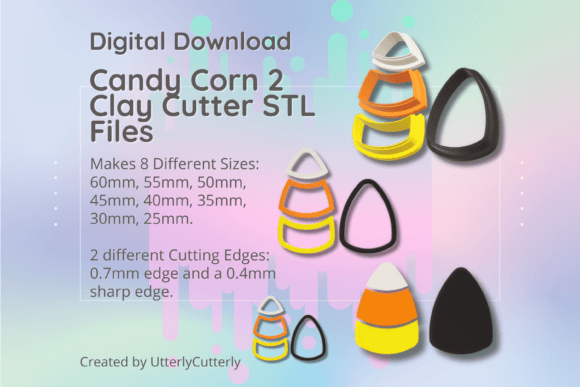
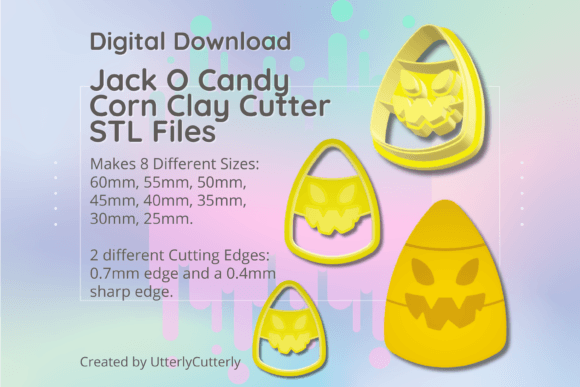
The Clay Cutter STL File Candy Corn 1 - Hall represents a specific node in the digital fabrication workflow for polymer clay artists, bakers, and jewelry makers. Rather than a standalone product, this digital download functions as a foundational asset within a broader production ecosystem. For creators managing small businesses or personal studios, understanding how to leverage this STL file effectively requires looking beyond the novelty of the shape and focusing on technical specifications, print reliability, and application versatility. This bundle serves as a bridge between digital design and tangible output, allowing for precise replication of Halloween-themed designs across various mediums.
Technical Specifications and Print Preparation
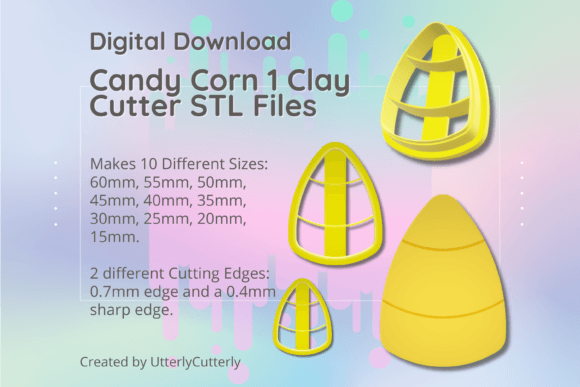
Successful integration of the Clay Cutter STL File Candy Corn 1 - Hall begins with proper slicer configuration. The bundle includes two distinct cutter profiles designed for different material viscosities and finish requirements. Understanding the distinction between these profiles is critical for reducing failed prints and ensuring clean cuts during the production phase.
- Standard Wall (0.7mm): This profile features a 0.7mm wall thickness with a 3mm thick base and a total height of 12mm. It offers increased durability for stiffer materials like cold porcelain or firm cookie dough. The thicker wall reduces the risk of layer separation during high-pressure use.
- Sharp Edge (SE): Abbreviated as SE in the file directory, this variant utilizes a 1mm support wall tapering to a 0.4mm cutting edge. With the same 3mm base and 12mm height, this geometry is optimized for polymer clay and fondant where minimal drag and clean release are priorities. The sharper edge reduces distortion in soft materials but requires careful handling to prevent damage.
Before initiating a print job, verify that your nozzle diameter aligns with these wall thicknesses. A 0.4mm nozzle is standard for the SE files, while the 0.7mm wall may benefit from a larger nozzle or adjusted flow rates to ensure solid extrusion without gaps. The 3mm reinforced base is a deliberate design choice intended to provide rigidity; do not reduce base layers in an attempt to save filament, as this compromises the structural integrity required for repeated pressing.
Sizing Strategy and Workflow Scalability
Versatility in creative workflows often depends on having the right scale for the specific application. This STL pack addresses that need by providing ten discrete sizes ranging from 15mm to 60mm. These measurements refer to the longest dimension of the candy corn shape. Incorporating this range into your inventory allows for modular project planning without requiring additional design time.
- Jewelry Fabrication (15mm – 30mm): The smaller increments are engineered for earrings, pendants, and barrettes. At these scales, the Sharp Edge (SE) variant is typically superior as it minimizes clay displacement on delicate pieces.
- Mixed Media and Charms (35mm – 45mm): Mid-range sizes serve as transitional assets suitable for keychains, bag charms, or decorative accents on larger ceramic vessels.
- Culinary and Large Decor (50mm – 60mm): The largest cutters are optimized for cookies and fondant. When working at this scale with food products, the Standard Wall (0.7mm) provides the necessary leverage and resistance against bending.
For entrepreneurs curating seasonal collections, this size gradation enables product line expansion from a single digital asset. Instead of designing new shapes, you can offer tiered pricing based on size or create cohesive sets (e.g., a "miniature" earring set paired with a matching pendant) using the same geometric language. This consistency streamlines photography, listing creation, and packaging processes.
Material Compatibility and Embossing Considerations
A critical technical detail in the Clay Cutter STL File Candy Corn 1 - Hall documentation concerns embossing depth. If the selected file includes internal detailing lines, they are set at a height of 10.5mm relative to the cutting edge. This specification dictates material preparation protocols.
To achieve a crisp impression without bottoming out or tearing the material, your rolled clay or fondant must exceed 1.5mm in thickness. In practice, aiming for 2mm to 2.5mm provides a safety margin that accounts for compression during the cutting action. If you routinely work with thinner sheets (under 1.5mm), you may need to modify the Z-scale in your slicer or select a non-embossed version if available. Ignoring this tolerance leads to inconsistent results and wasted material, disrupting efficient batch production.
Furthermore, material type influences cutter selection. Polymer clay benefits from the SE profile due to its plasticity, whereas cookie dough often requires the sturdier 0.7mm wall to withstand the density of the mixture. Fondant falls somewhere in between; testing both profiles with your specific brand of fondant is recommended to determine which yields the cleanest release. Documenting these findings creates a personal reference guide that accelerates future decision-making.
Digital Asset Management and Integration
As a digital download, this item exists purely as data until fabricated. Efficient management of STL files is as important as the printing process itself. Upon purchase, immediate organization prevents workflow friction later. Establish a standardized folder hierarchy on your local drive or cloud storage, such as Halloween > Candy Corn > STL > [Size]_[Type].
Naming conventions matter when dealing with twenty unique files (10 sizes × 2 types). Renaming files upon download to include key specs (e.g., CandyCorn_40mm_SE.stl) eliminates guesswork during slicing. This is particularly relevant when integrating with other STL files from our store. New designs are added weekly, and maintaining a consistent organizational structure allows you to mix and match assets rapidly. For example, pairing the Candy Corn cutters with complementary bat or pumpkin STLs becomes a simple drag-and-drop operation rather than a search task.
For users operating multiple printers or sharing resources within a studio, centralizing these files ensures version control. Always retain the original downloaded files as master copies. Sliced G-code files should be stored separately or named distinctly to avoid accidentally printing a file configured for PLA when PETG is loaded, or vice versa.
Post-Processing and Quality Control
The output quality of 3D printed cutters directly impacts the finish of the final clay or food product. Layer lines from FDM printing can transfer to soft materials, creating unwanted texture. Integrating a post-processing step into your workflow ensures professional results.
- Sanding: Focus exclusively on the cutting rim and any embossing details. Use high-grit sandpaper (600–1000) wet-sanded to smooth layer artifacts. For the SE variant, maintain the bevel angle to preserve cutting efficiency.
- Coating: Applying a thin layer of food-safe epoxy or UV resin can seal layer lines entirely. This is mandatory for culinary use and highly recommended for polymer clay to prevent sticking. Allow full cure time before introduction to production.
- Lubrication: During use, a light dusting of cornstarch or water spray acts as a release agent. This operational habit extends cutter life and improves demolding success rates.
Quality control should occur after every print run. Inspect the first layer adhesion and top surface finish before committing to a full batch. A warped base renders a cutter unusable regardless of edge sharpness. By validating prints immediately, you avoid discovering defects mid-project when clay has already been conditioned and prepared.
Long-Term Utility and Business Application
Investing in the Clay Cutter STL File Candy Corn 1 - Hall is an investment in repeatable manufacturing capability. Unlike physical cutters that may degrade or go out of stock, digital files offer indefinite utility. If a cutter breaks during peak season, a replacement can be printed in under an hour. This resilience is vital for small business continuity.
Moreover, owning the digital asset grants flexibility in customization. Advanced users can import these STLs into CAD software to add text, modify proportions, or combine shapes before printing. While the provided sizes cover most needs, the ability to adapt the source file transforms a static product into a dynamic tool. This adaptability supports niche markets and bespoke commissions that off-the-shelf tools cannot address.
Ultimately, this STL bundle is a component of a larger creative infrastructure. Its value is realized not just in the initial print, but in how seamlessly it integrates into your existing processes—from file management and printer calibration to material selection and final finishing. By treating digital fabrication with the same rigor as traditional craft techniques, creators can achieve consistent, scalable, and high-quality outcomes throughout the Halloween season and beyond.