Clay Cutter STL File Snowflake 2 - Chris: Technical Specifications and Practical Applications
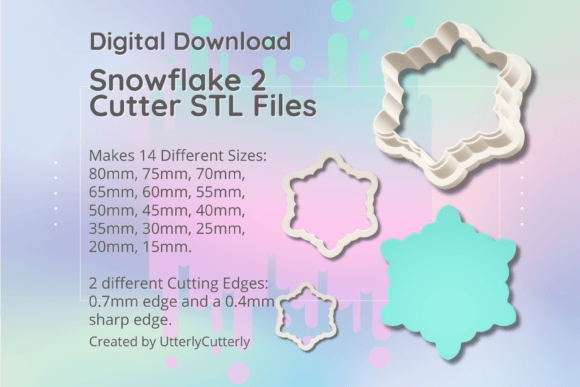
The Clay Cutter STL File Snowflake 2 - Chris represents a specialized digital asset designed for makers who require precision and versatility in their crafting workflow. As a digital download, this bundle provides immediate access to high-resolution stereolithography files optimized for FDM and resin 3D printing. Unlike generic seasonal templates, this specific design package focuses on functional engineering, offering two distinct cutting edge profiles and fourteen incremental sizes. This level of granularity allows professionals, small business owners, and serious hobbyists to produce consistent results across various mediums, from polymer clay jewelry to culinary applications like fondant and cookies.
For creators evaluating digital fabrication resources, the value of this STL pack lies in its adaptability. The design moves beyond simple aesthetics to address common pain points in cutter manufacturing, such as wall thickness, support requirements, and material compatibility. By providing both standard and sharp-edge variations, the Clay Cutter STL File Snowflake 2 - Chris enables users to select the appropriate tool geometry based on the specific viscosity and texture of their working material. This technical flexibility makes it a practical addition to any digital maker library, particularly for those producing items for commercial sale or personalized gifting.
Technical Profiles and Print Optimization
A critical aspect of evaluating any cutter STL is understanding the relationship between nozzle diameter, layer height, and structural integrity. This bundle addresses these variables by including two distinct cutter types, each engineered for specific performance characteristics. Understanding these differences is essential for achieving optimal print quality and tool longevity.
Standard Wall Configuration
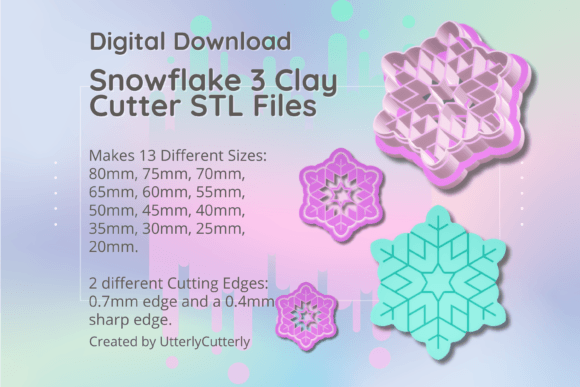
The first profile features a 0.7mm wall with a 3mm thick base and a total height of 12mm. This configuration is generally more forgiving for printers with standard 0.4mm nozzles. The 0.7mm wall typically prints as two perimeters, providing sufficient rigidity for denser clays without excessive flexing. The 3mm base ensures stability during the pressing motion, reducing the risk of the cutter twisting and distorting the snowflake shape. This version is often preferable for earthenware clay, thicker polymer blends, or cookie dough where extreme sharpness is less critical than durability.
Sharp Edge (SE) Variant
Labeled as "SE" in the file directory, the Sharp Edge variant utilizes a 1mm support wall tapering to a 0.4mm cutting edge. Maintaining the same 3mm base and 12mm height as the standard version, this profile prioritizes clean incisions over bulk strength. The 0.4mm edge is designed to slice through delicate materials like translucent polymer clay or rolled fondant with minimal drag. However, users should note that printing a functional 0.4mm edge requires precise flow rate calibration and potentially a hardened steel nozzle to prevent wear. This variant is ideal for intricate jewelry components where post-processing cleanup time must be minimized.
Dimensional Versatility and Sizing Strategy
Consistency in sizing is paramount for product lines involving sets or graduated designs. The Clay Cutter STL File Snowflake 2 - Chris includes fourteen discrete sizes ranging from 15mm to 80mm in 5mm increments. This systematic scaling offers significant advantages over single-size downloads or arbitrary sizing found in free repositories.
- Jewelry Production: The 15mm to 30mm range covers standard earring studs, pendants, and charm dimensions. Having multiple sizes within this bracket allows for creating cohesive collections rather than isolated pieces.
- Mixed Media Projects: Mid-range sizes (35mm to 55mm) serve dual purposes, functioning effectively as barrette bases, ornament centers, or large decorative elements on greeting cards.
- Culinary and Decor: Larger sizes (60mm to 80mm) are optimized for cookies and cake toppers. The 5mm step between sizes facilitates nesting arrangements or tiered visual displays.
Cutter measurements are taken from the longest ends of the snowflake geometry. Makers should account for this when planning layout efficiency on print beds or calculating material usage for clay sheets. The availability of this full spectrum in a single bundle eliminates the need to source mismatched files from different designers, ensuring uniform line weight and stylistic coherence across an entire project suite.
Material Compatibility and Embossing Considerations
While primarily marketed as cutters, the inclusion of embossing details adds a layer of complexity to the printing and usage process. Any embossing lines within the Clay Cutter STL File Snowflake 2 - Chris design stand at 10.5mm tall. Given the total cutter height of 12mm, this leaves only 1.5mm of clearance above the embossed feature.
This specification dictates strict material thickness requirements. For the embossing to register clearly without bottoming out or causing the cutter to stick, the clay or dough must be conditioned to a thickness greater than 1.5mm. Users working with very thin sheets (e.g., 1mm veneers) should utilize the cutter solely for outline cutting or adjust their slab roller settings accordingly. In professional practice, testing the emboss depth on scrap material before committing to final production runs is recommended to verify that the 1.5mm differential provides adequate relief for your specific medium's elasticity and memory.
Workflow Integration for Creators and Small Businesses
For entrepreneurs and freelancers, digital assets must justify their cost through time savings and product differentiation. This STL bundle supports several commercial and creative workflows:
- Rapid Prototyping: Test market response to new snowflake jewelry designs without investing in metal die manufacturing. The ability to print a test cutter in under thirty minutes allows for agile product development.
- Customization Services: Offer clients bespoke sizing options. If a customer requests a specific ornament size for a tree with limited space, you can print the exact dimension needed rather than forcing a standard size.
- Seasonal Inventory Management: Digital inventory eliminates storage costs associated with physical aluminum or plastic cutters. Files can be archived and reprinted on demand, reducing overhead for seasonal businesses.
- Educational Resources: Educators and workshop leaders can provide students with identical tools regardless of supply chain fluctuations, ensuring consistent learning outcomes in ceramics or polymer clay classes.
Evaluating Quality and Long-Term Value
When assessing the Clay Cutter STL File Snowflake 2 - Chris, potential users should consider the long-term utility of the file geometry. High-quality cutter STLs are characterized by manifold meshes, proper orientation for printing, and consideration of printer tolerances. The dual-profile approach in this bundle suggests a designer awareness of real-world printing limitations, which typically correlates with higher success rates and fewer failed prints.
Furthermore, the modular nature of this pack encourages integration with other STL files. Because the sizing follows a predictable 5mm progression, these snowflakes can be easily combined with other geometric or organic shapes from the same designer ecosystem to create complex composite tools or coordinated product lines. This interoperability enhances the return on investment, as the files become building blocks for future designs rather than standalone novelties.
Practical Recommendations and Limitations
To maximize the effectiveness of this digital download, users should adhere to several best practices. First, always use a brim or raft when printing the larger sizes (60mm+) to prevent warping, as the wide base surface area can lift off the build plate during cooling. Second, while the SE variant offers superior cutting performance, it is inherently more fragile; store these cutters separately or in protective cases to prevent edge damage. Third, recognize that this is a digital product requiring user competency in slicer software. Beginners may need to experiment with perimeter counts and infill patterns to achieve the specified wall thicknesses accurately.
It is also important to acknowledge limitations. Plastic cutters, regardless of print quality, have a finite lifespan compared to metal alternatives. They are excellent for short-to-medium run production and prototyping but may show wear after extensive use with abrasive materials like grog-heavy clay. Additionally, the embossing limitation means this tool is not suitable for ultra-thin appliqué work. Users requiring sub-1.5mm embossing capabilities should seek alternative files specifically designed for veneer techniques.
Ultimately, the Clay Cutter STL File Snowflake 2 - Chris serves as a robust, technically sound resource for makers who understand their equipment and materials. Its comprehensive size range and thoughtful engineering make it a reliable choice for producing professional-grade holiday items, jewelry, and confections. By leveraging the included technical specifications and adhering to recommended print parameters, creators can efficiently expand their seasonal offerings with confidence in both the process and the final result.