Wiggle Triangle 2 Clay Cutter: Mid-Cent STL Files
The intersection of mid-century modern aesthetics and contemporary maker culture offers endless opportunities for unique design. The Wiggle Triangle 2 Clay Cutter captures this specific visual language, translating the playful geometry of the 1950s and 60s into a functional digital asset. This isn't just another shape; it is a curated design element that brings retro sophistication to polymer clay jewelry, ceramic pendants, and even culinary projects. By utilizing these STL files, creators can bypass the tedious process of hand-carving complex curves and move directly to production with professional-grade consistency.
This digital download provides immediate access to a versatile toolkit designed for both aesthetic appeal and practical manufacturing. Whether you are a small business owner expanding your earring line or a hobbyist experimenting with fondant, having precise control over size and edge definition is essential. The Wiggle Triangle 2 allows for rapid iteration, enabling you to test different scales and styles without committing to physical inventory until the design is perfected.
Understanding the Technical Specifications
Successful 3D printing for clay cutting requires more than just a generic model; it demands engineering tailored to material resistance and release. This bundle includes two distinct cutter profiles to accommodate different materials and finishing preferences. Understanding the difference between these edges ensures your final product meets professional standards.
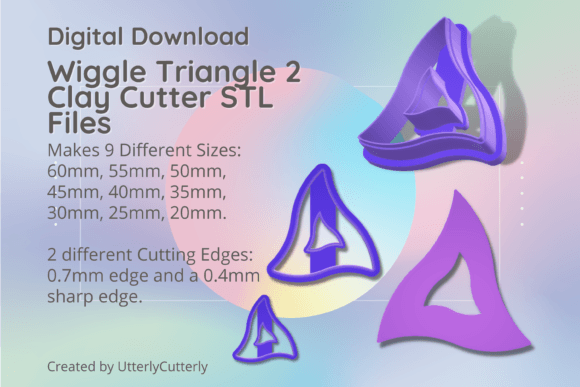
- Standard Edge (0.7mm Wall): Featuring a 0.7mm wall thickness, a 3mm reinforced base, and a 12mm height, this cutter offers durability. It is ideal for firmer clays or repeated use in high-volume production. The slightly thicker wall provides structural integrity during the pressing motion, reducing the risk of warping over time.
- Sharp Edge (SE): Abbreviated as SE in the file names, this variation features a 1mm support wall tapering to a precise 0.4mm cutting edge. With the same 3mm base and 12mm height, this option is engineered for clean cuts in softer materials like porcelain clay or delicate cookie dough. The sharper profile reduces drag, resulting in smoother edges that require less post-processing sanding.
Both variations maintain a consistent 12mm height, which serves a dual purpose: it provides ample surface area for gripping and ensures clearance for clay depths up to 10.5mm. If you plan to utilize embossing lines, ensure your conditioned clay slab exceeds 1.5mm in thickness to prevent bottoming out and to allow the texture to register clearly.
Strategic Sizing for Product Cohesion
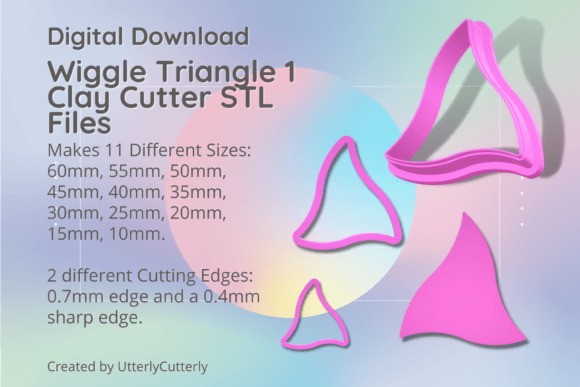
One of the primary challenges in handmade product development is maintaining visual harmony across a collection. Randomly sized components can make a lineup feel disjointed. This STL pack addresses that friction by offering nine graduated sizes measured from the longest ends: 60mm, 55mm, 50mm, 45mm, 40mm, 35mm, 30mm, 25mm, and 20mm.
This incremental scaling allows for intentional curation rather than guesswork. For jewelry designers, the 20mm to 35mm range is optimal for lightweight stud earrings and charm bracelets, where weight distribution affects wearability. The 40mm to 50mm sizes work beautifully as statement pendants or hair barrettes, providing enough surface area for intricate color blending or mica shift techniques. The larger 55mm and 60mm cutters bridge the gap between jewelry and home decor, suitable for large resin-filled pieces, ornament bases, or substantial cookie decorations.
Having access to the full spectrum means you can create nested sets or gradient collections. A set of three wiggle triangle studs in descending sizes creates a cohesive narrative that encourages customers to purchase multiple items. This level of organization is difficult to achieve with freeform cutting but becomes effortless with calibrated digital files.
Creative Applications Beyond Jewelry
While polymer clay earrings are the most common application, the mid-century wiggle motif translates exceptionally well to other mediums. Diversifying your output maximizes the return on investment for these digital assets.
Culinary and Fondant Design
The Sharp Edge (SE) files are specifically optimized for food-safe applications when printed in appropriate materials. The wiggle triangle adds a retro flair to sugar cookies, fondant cake toppers, and buttercream accents. Because the geometry relies on smooth curves rather than sharp internal corners, dough releases easily without sticking. This makes the cutter efficient for batch baking, where speed and uniformity are critical. Consider pairing these shapes with vintage color palettes—mustard yellows, teals, and burnt oranges—to fully leverage the mid-century theme for themed events or seasonal menus.
Mixed Media and Resin Art
Use the larger cutters to create silicone molds or direct resin bezels. The organic movement of the wiggle triangle breaks up the static nature of traditional geometric resin art. You can embed dried flowers, gold leaf, or alcohol inks within the boundaries defined by the cutter. The consistent sizing ensures that if you are casting multiple pieces for a gallery wall or a set of coasters, every unit aligns perfectly.
Optimizing Your 3D Printing Workflow
To get the best results from the Wiggle Triangle 2 STL files, treat the printing process as part of your quality control. Since these are designed for easy printing, they generally do not require supports, but orientation matters. Print with the cutting edge facing up to avoid bed adhesion issues affecting the blade's precision. Use a brim only if necessary for stability, as removing brims from thin cutting edges can be risky.
Material selection also influences performance. PLA is standard and sufficient for most polymer clay work, but PETG or ABS offers better heat resistance if you are working with warm clay or using the cutters in warmer environments. Always verify your printer’s dimensional accuracy before running a full batch; a quick test print at 20mm can save hours of wasted filament if your flow rate needs calibration. Remember, this is a digital product. You receive the data immediately after purchase, allowing you to iterate on print settings and material choices instantly without waiting for shipping.
Building a Unique Brand Identity
In a saturated market, distinctiveness comes from how tools are applied, not just the tools themselves. The Wiggle Triangle 2 serves as a foundational element, but your creative interpretation defines the brand. Experiment with modifying the clay after cutting. Use needle tools to add hand-drawn details that contrast with the machine-perfect outline. Combine the wiggle triangle with other mid-century STL files from our weekly releases to build a proprietary shape library that competitors cannot replicate.
Consistency builds trust. When your audience recognizes the specific curvature and proportion of your work, it reinforces brand recall. By utilizing these standardized digital cutters, you ensure that whether you are making a single prototype or a production run of five hundred, the core identity remains stable. This reliability frees up mental energy to focus on color theory, surface design, and marketing, knowing that the structural foundation of your work is secure.
Ultimately, these STL files are an invitation to explore the tension between digital precision and handmade warmth. They provide the structure needed for professional results while leaving ample room for personal expression. Whether you are crafting edible art, wearable accessories, or decorative objects, the Wiggle Triangle 2 equips you to bring mid-century modernism into the present day with confidence and efficiency.