Frill Hoop 2 Clay Cutter: Retro 60s 70s STL Files
The resurgence of mid-century aesthetics has created a significant demand for tools that capture the playful yet structured geometry of the era. For polymer clay artists, ceramicists, and cookie decorators, achieving authentic retro silhouettes often requires specialized equipment that is not readily available in standard craft stores. The Frill Hoop 2 Clay Cutter - Retro 60s 70s digital collection addresses this gap by providing precise, printable STL files designed specifically for modern fabrication. This resource allows creators to bypass shipping delays and limited inventory, offering immediate access to eight distinct sizes and two specialized cutting edge profiles tailored for both delicate jewelry and culinary applications.
Optimizing Print Settings for Dual Edge Profiles
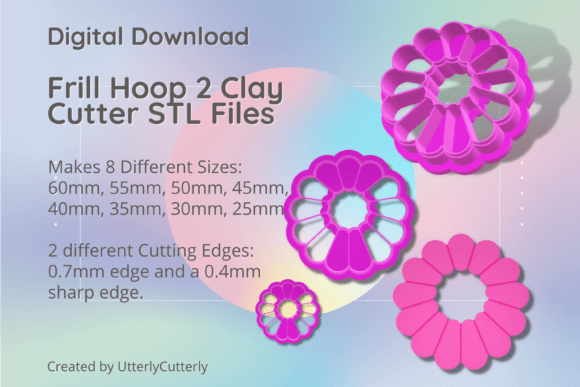
One of the primary advantages of this digital bundle is the inclusion of two distinct cutter types within the same design ecosystem. Understanding the technical differences between these profiles is essential for achieving professional results. The first option features a 0.7mm wall thickness with a 3mm base and a total height of 12mm. This profile is engineered for durability and general-purpose use. The thicker wall provides structural rigidity during the cutting process, making it ideal for stiffer clays or doughs where lateral pressure might distort thinner cutters. This version is particularly useful for beginners or those working with materials that require significant force to slice cleanly.
Conversely, the Sharp Edge (SE) variant offers a refined alternative for detailed work. Abbreviated as SE in the file names, this cutter maintains the same 3mm base and 12mm height but utilizes a 1mm support wall tapering to a 0.4mm cutting edge. This reduced contact area significantly decreases drag, resulting in cleaner cuts with minimal material displacement. For jewelry makers creating lightweight earrings or pendants, the SE profile reduces the need for post-processing sanding. When printing these files, users should consider their specific application; the 0.7mm wall is versatile and robust, while the 0.4mm SE demands careful handling but rewards the user with superior edge definition.
Strategic Size Selection for Cohesive Collections
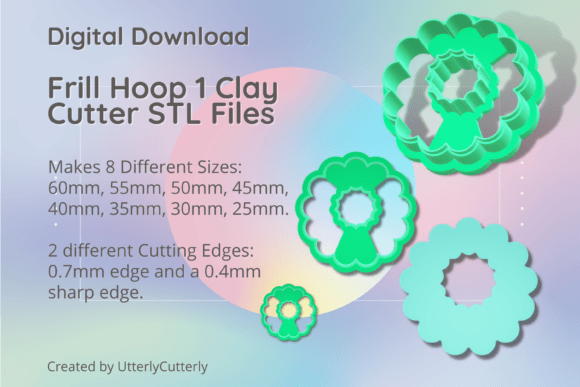
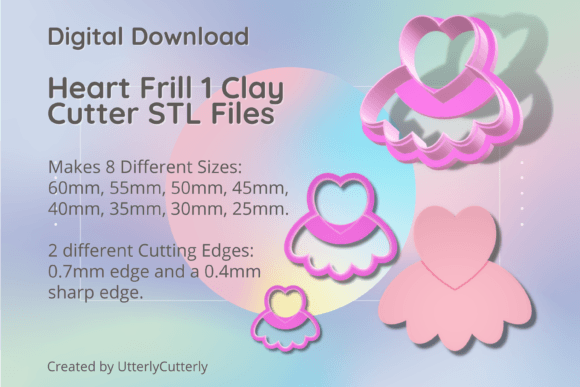
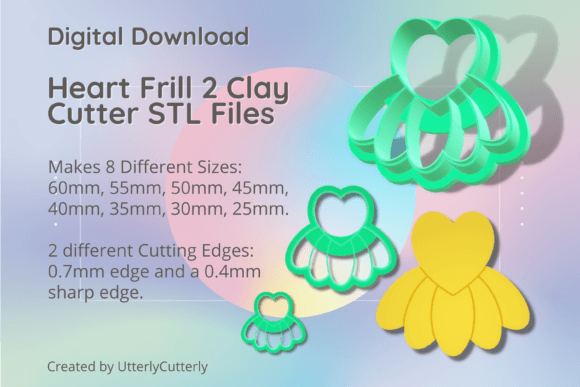
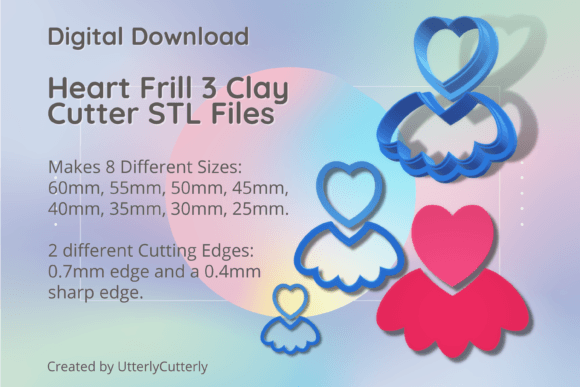
Versatility in design often hinges on scale. This STL pack includes eight graduated sizes measured from the longest ends: 60mm, 55mm, 50mm, 45mm, 40mm, 35mm, 30mm, and 25mm. Having this specific range available digitally allows creators to curate cohesive product lines without sourcing mismatched tools from different manufacturers. For example, a jewelry designer can utilize the 25mm and 30mm cutters for stud earrings, the 40mm and 45mm for standard dangles, and the 55mm or 60mm for statement pieces, all while maintaining consistent line weight and proportion.
This scalability also benefits educators and workshop leaders who need to accommodate varying skill levels and project scopes. Smaller sizes are generally more forgiving for students learning to handle clay, while larger formats challenge experienced makers to manage material stability. Because these are digital files, you can print only the sizes relevant to your current project, reducing plastic waste and storage requirements compared to purchasing physical sets.
Technical Considerations for Embossing and Material Depth
While primarily designed as outline cutters, the Frill Hoop 2 geometry interacts predictably with clay depth, which is a critical factor for success. If utilizing the embossing lines present in certain variations, note that they stand 10.5mm tall. This specification dictates that you must work with clay conditioned to a thickness greater than 1.5mm to ensure the cutter does not bottom out or fail to register the impression clearly. Attempting to use these cutters on thinly rolled sheets may result in incomplete shapes or damaged embossing details.
This depth requirement serves as a practical quality control checkpoint. It encourages makers to maintain consistent slab thickness, which directly correlates to even baking times and structural integrity in finished jewelry. For cookie decorators, this height accommodates standard royal icing flooding depths and fondant layers without compromising the shape's definition. Always verify your clay roller settings against the 12mm total cutter height before beginning production runs to avoid wasted material and time.
Integrating Digital Assets into Creative Workflows
Transitioning from physical tools to digital STL files requires a shift in workflow management. Since this is not a physical item, access is granted immediately upon payment, eliminating lead times. This immediacy supports agile creative processes where inspiration strikes unexpectedly or client deadlines are tight. However, it also places the responsibility of print calibration on the user. Before committing to a full production run, it is advisable to print a single test cutter to verify dimensional accuracy and layer adhesion on your specific machine.
All cutters in this collection are tested prior to release, but printer tolerances vary. Factors such as nozzle diameter, cooling fan efficiency, and filament type can influence the final cutting edge quality. PLA is generally recommended for its stiffness and ease of printing, though PETG may be preferred for food-safe applications due to its higher heat resistance and chemical stability. By treating the STL file as a raw ingredient rather than a finished tool, makers can fine-tune their output to match their exact operational needs.
Expanding Design Possibilities Through Modular Compatibility
The Frill Hoop 2 system is designed with interoperability in mind. The standardized sizing and aesthetic language allow these cutters to integrate seamlessly with other retro-themed STL files released weekly. This modular approach enables creators to build extensive libraries of complementary shapes that share visual DNA. Rather than viewing each cutter in isolation, consider how the frill hoop geometry pairs with other mid-century motifs like atomic stars, daisies, or mod waves.
For small business owners, this compatibility translates to brand consistency. Customers recognize and trust a unified aesthetic across product drops. By utilizing a coordinated set of digital cutters, you ensure that every piece, regardless of when it was designed, feels part of a larger narrative. This level of curation is difficult to achieve with disparate physical tools but becomes effortless with a dedicated digital library. Furthermore, as new designs are added to the store regularly, your toolkit evolves without requiring additional storage space or capital investment in inventory.
Practical Applications Across Mediums
While polymer clay is the most common medium for these cutters, the dual-edge design extends their utility to other materials. The 0.7mm wall version performs exceptionally well with air-dry clays and ceramic slabs, where the extra rigidity prevents warping during the slower drying process. In culinary contexts, the sharp edge variant excels at cutting through chilled buttercookie dough or marzipan without dragging, preserving the intricate frill details that define the retro aesthetic.
Educators and content creators also find value in the digital format itself. Being able to showcase the design process—from screen to printer to finished object—adds an engaging layer of transparency for audiences interested in maker culture. The ability to customize print colors further enhances this storytelling potential, allowing for color-coded organization or branded packaging elements. Whether producing high-end wearable art or whimsical baked goods, the Frill Hoop 2 Clay Cutter - Retro 60s 70s STL bundle provides the technical foundation necessary to execute vintage-inspired visions with modern precision.