Frill Heart 3 Clay Cutter - Valentines L: Optimizing Your Digital STL Files for Professional Results
The Frill Heart 3 Clay Cutter - Valentines L represents a significant step up for creators looking to add intricate, romantic details to their polymer clay or cookie projects. As a digital download STL file bundle, this collection offers immediate access to versatile designs that bridge the gap between seasonal Valentine’s crafts and year-round aesthetic jewelry making. However, transitioning from physical tools to 3D-printed cutters requires a shift in mindset. Many makers underestimate the technical nuances of printing and using digital cutter files, leading to frustration with layer lines, fragile edges, or sizing inconsistencies.
Understanding the specific engineering behind these files is not just about getting a print to finish; it is about ensuring the final tool performs reliably in clay or dough. This guide addresses common oversights when working with the Frill Heart 3 collection and provides corrective strategies to maximize your investment in these digital assets.
Distinguishing Between Cutting Edge Profiles
One of the most frequent mistakes occurs during the file selection phase. This bundle includes two distinct cutting edge types, and choosing the wrong one for your specific material can ruin both the print and your project. The files are categorized into standard walls and Sharp Edge (SE) variants.
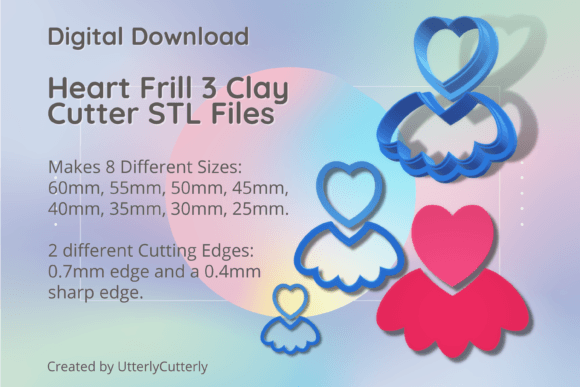
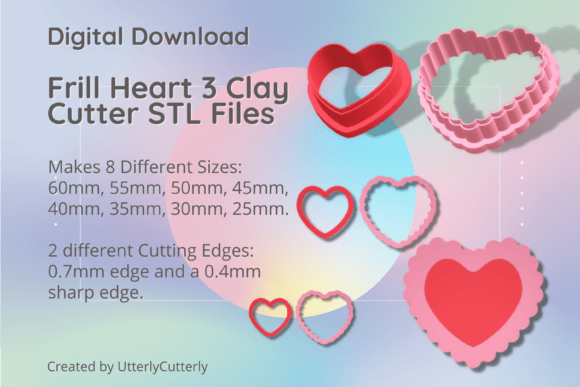
- Standard 0.7mm Wall: Features a 0.7mm wall thickness, a 3mm thick base, and a 12mm height. This is the durable workhorse option.
- Sharp Edge (SE): Abbreviated as SE in the filenames, this version has a 1mm support wall tapering to a precise 0.4mm cutting edge, with identical base and height dimensions.
Why this matters: Beginners often default to the Sharp Edge SE files assuming thinner is always better. While the 0.4mm edge produces cleaner cuts in soft polymer clay, it is significantly more prone to warping during printing and breaking during use if excessive pressure is applied. Conversely, using the standard 0.7mm wall on very soft fondant may result in dragging rather than slicing.
Better Approach: Audit your primary medium before printing. Reserve the SE files for conditioned polymer clay where precision is paramount and you have experience handling delicate prints. Use the standard 0.7mm files for cookies, firmer clays, or if you are new to 3D printed cutters. Having both options in this bundle is an advantage, but only if matched correctly to the task.
Navigating Size Selection and Measurement Standards
Sizing confusion is a pervasive issue with digital cutter marketplaces. When curating custom combos for earrings or charms, assuming standard measurement conventions can lead to mismatched sets. The Frill Heart 3 Clay Cutter - Valentines L pack includes eight sizes: 60mm, 55mm, 50mm, 45mm, 40mm, 35mm, 30mm, and 25mm.
A critical detail often overlooked is that cutter size is measured from the longest ends. For frilled heart shapes, this typically means the measurement spans from the top curve of the frill to the bottom point, not the width across the center. Makers who plan based on width often end up with cutters that are taller than anticipated, disrupting earring symmetry or cookie layout.
Practical Correction: Always measure your design space vertically when planning with heart silhouettes. If you are integrating these with other STL files from our store, verify that those files use the same measurement convention. Creating a test print at the smallest size (25mm) is an efficient way to validate scale before committing filament to larger versions.
Managing Embossing Depth and Clay Thickness
If your selected STL files include embossing details, ignoring depth specifications is a guaranteed path to wasted material. Any embossing lines in this design set are 10.5mm tall. This is a functional constraint, not merely a design choice.
This specification dictates that you must work with clay thicker than 1.5mm. Since the total cutter height is 12mm, subtracting the 10.5mm emboss feature leaves exactly 1.5mm of clearance. If your clay slab is rolled thinner than this threshold, the embosser will bottom out against your work surface before the cutting edge fully penetrates the material. The result is a partially cut shape with compressed texture rather than a clean impression.
Solution: Use consistent slat rollers or clay thickness guides set to at least 2mm when using embossed variants. This provides a safety margin that ensures full engagement of the cutting edge while preserving the intended texture depth.
Optimizing Print Settings for Durability
Treating all STL files with identical slicer settings is a common efficiency killer. The geometry of frilled hearts presents specific challenges regarding bed adhesion and structural integrity. The 3mm thick base provides stability, but the intricate frills create multiple small contact points that can lift during printing.
Rather than relying solely on brims—which require post-processing cleanup that can dull cutting edges—focus on first-layer optimization. Ensure your bed leveling is precise and consider using a textured PEI sheet or appropriate adhesive for your filament type. For the Sharp Edge SE variants, reducing print speed for outer walls can improve edge definition without compromising the 0.4mm tip geometry.
Additionally, verify your nozzle diameter compatibility. These files are designed for standard 0.4mm nozzles. Attempting to print the SE cutting edge with a worn or larger nozzle will fail to achieve the specified tolerance, resulting in a blunt tool regardless of the digital design quality.
Digital Asset Management and Expectations
Finally, clarify your purchasing expectations to avoid disappointment. This is not a physical item. You receive digital STL files accessible immediately after payment. There is no shipping, no unboxing, and no manufacturer warranty on a plastic tool—you are acquiring the blueprint to manufacture your own tools.
This distinction shifts quality control to you. Before starting a production run for Valentine’s Day orders, allocate time for calibration prints. Test the 0.7mm and SE variants side-by-side with your specific clay body. Document which settings yield the best release and cut quality for your workflow. This upfront testing prevents mid-project failures when deadlines are tight.
By respecting the technical parameters of the Frill Heart 3 Clay Cutter - Valentines L bundle—from edge selection and sizing conventions to embossing tolerances—you transform a simple digital download into a reliable production asset. New STL files are added to our store weekly, allowing you to expand your collection systematically. Approach each new file with the same technical diligence, and your handmade creations will consistently reflect professional standards.