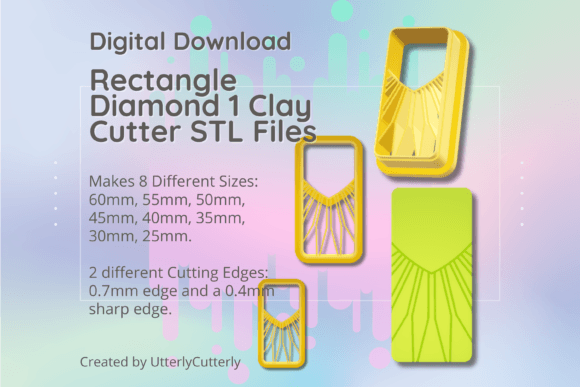
Clay Cutter STL File Rectangle Diamond 1 Guide
For creators working with polymer clay, fondant, or cookie dough, achieving consistent geometric precision is often the difference between a professional finish and an amateur result. The Clay Cutter STL File Rectangle Diamond 1 provides a digital solution to this common fabrication challenge. Rather than relying on mass-produced plastic cutters that may warp or lack specific dimensions, this digital download allows you to manufacture your own tools tailored to exact project requirements. This bundle of rectangle diamond clay cutters serves as a foundational asset for makers who require versatility across multiple mediums, from delicate jewelry components to culinary decorations.
Accessing high-quality STL files means you are not limited by inventory shipping times or discontinued products. Once downloaded, these files become a permanent part of your digital workshop. Whether you are producing earrings, pendants, barrettes, or edible art, having immediate access to eight distinct sizes ensures that your creative workflow remains uninterrupted. This guide explores how to leverage these specific digital assets to improve production efficiency and expand your design capabilities.
Selecting the Right Blade Profile for Your Medium
One of the most critical aspects of using 3D printed cutters is understanding that different materials require different blade geometries. This pack includes two distinct cutter types designed to address the varying resistance and texture of clay versus food products. Recognizing which file to print prevents material waste and reduces post-processing time.
The Standard 0.7mm Wall Configuration
The standard version features a 0.7mm wall thickness with a 3mm thick base and a total height of 12mm. This robust profile is engineered for durability and ease of handling. It is particularly effective when working with firmer polymer clays or when cutting thicker slabs where structural rigidity is necessary to prevent the cutter from flexing during use. The wider wall also makes this version easier to clean, as there is less risk of material becoming trapped in narrow crevices. For general-purpose crafting and repetitive production runs, this is typically the recommended starting point.
The Sharp Edge (SE) Variant
Files abbreviated as SE in the download package feature a specialized geometry: a 1mm support wall tapering to a precise 0.4mm cutting edge. Like the standard version, it maintains a 3mm base and 12mm height, but the reduced contact surface at the cutting point significantly lowers friction. This sharp edge variant is essential for soft or sticky materials, such as fresh fondant, marzipan, or conditioned polymer clay. The thinner edge slices through the medium cleanly rather than displacing it, resulting in crisp boundaries that require minimal smoothing. However, users should note that while the SE version offers superior finish quality, it may be more susceptible to damage if used with extremely hard materials or excessive force.
Strategic Sizing for Cohesive Collections
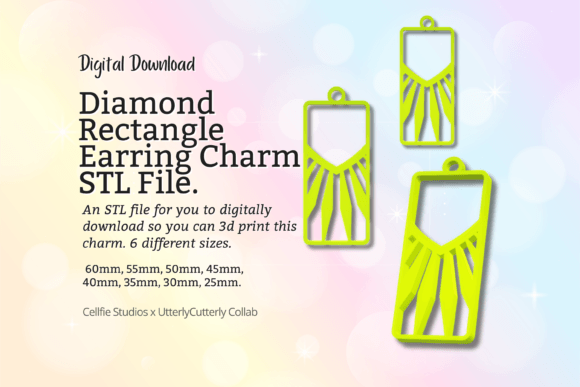
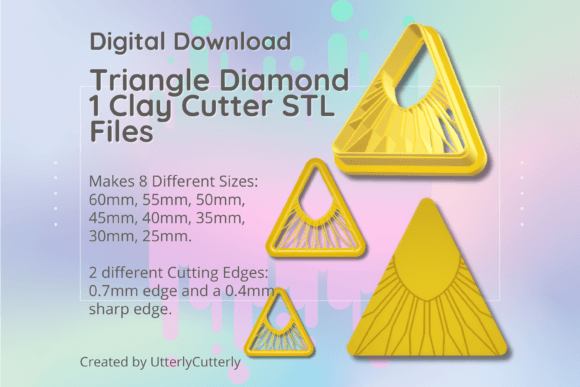
Consistency in scale is vital when creating product lines or themed collections. The Clay Cutter STL File Rectangle Diamond 1 bundle eliminates guesswork by providing a graduated range of eight sizes: 60mm, 55mm, 50mm, 45mm, 40mm, 35mm, 30mm, and 25mm. These measurements refer to the longest ends of the diamond shape, ensuring predictable proportions regardless of the size selected.
This incremental sizing strategy supports several practical applications:
- Jewelry Sets: Create matching necklace and earring sets by pairing the 60mm pendant size with 30mm or 25mm earring components. The geometric similarity creates visual harmony while respecting the functional weight limits of ear wires.
- Nesting Designs: Use multiple sizes within a single piece to create framed effects or layered compositions. The consistent aspect ratio across all sizes ensures that nested diamonds remain parallel and aesthetically balanced.
- Culinary Uniformity: For bakers and cake decorators, having standardized sizes allows for precise portion control and symmetrical plating. The 40mm and 35mm sizes are often ideal for petit fours or cookie favors, while larger sizes suit statement cake toppers.
Because these are digital files, you can curate custom combinations easily alongside other STL files in our store. New designs are added weekly, allowing you to build a comprehensive library of complementary shapes that maintain professional consistency across your entire catalog.
Understanding Embossing Line Limitations
Some variations in this pack include embossing lines to add surface detail. It is important to understand the technical constraints of these features to avoid failed prints or damaged workpieces. Any embossing lines present are 10.5mm tall. Given the total cutter height of 12mm, this leaves only 1.5mm of clearance above the embossed feature. Consequently, you must work with clay or dough that is thicker than 1.5mm to accommodate the embosser without bottoming out. Attempting to use these cutters on thinner sheets will result in incomplete cuts or distorted impressions. Always measure your slab thickness before selecting an embossing variant.
Optimizing Print Settings for Functional Tools
Our cutters are designed to be easily printed, but achieving optimal performance requires appropriate slicer settings. Since these are functional tools rather than decorative models, mechanical properties take precedence over aesthetic layer lines.
- Orientation: Always print cutters vertically with the cutting edge facing up. This aligns the layer lines perpendicular to the cutting direction, maximizing strength along the blade. Printing horizontally creates weak points that can delaminate under pressure.
- Infill and Walls: A minimum of three perimeter walls is recommended to ensure the 0.7mm or 1mm blade structures are solid. Infill percentage is less critical due to the small cross-section, but 20-30% provides sufficient internal support for the handle/base area.
- Material Selection: PLA is suitable for most clay and fondant applications due to its stiffness and biodegradability. However, if you plan to wash cutters frequently in warm water or use them with abrasive materials, consider PETG for better thermal and chemical resistance. Avoid ABS for food-related projects unless specifically certified as food-safe.
- Nozzle Considerations: For the Sharp Edge (SE) variants with 0.4mm cutting edges, a 0.4mm nozzle is the maximum recommended size. Using a larger nozzle may fail to reproduce the thin cutting geometry accurately. A 0.25mm nozzle will yield even crisper results for detailed embossing features.
Maximizing Value Through Digital Ownership
Transitioning from physical tool purchases to digital STL files represents a shift toward sustainable and scalable making. With the Clay Cutter STL File Rectangle Diamond 1, you eliminate the environmental impact of shipping individual plastic items and gain the ability to replace worn tools instantly. If a cutter becomes damaged after months of heavy use, simply reprint it rather than waiting for a replacement order.
This model is particularly beneficial for educators and workshop leaders who need multiple identical sets for students, or for small business owners scaling production without increasing overhead costs. The ability to produce tools on-demand means your equipment inventory grows precisely in step with your creative needs. Remember that this is not a physical item; you will have access to download the files immediately after payment, enabling you to begin production within hours rather than days.
By integrating these versatile rectangle diamond cutters into your digital fabrication workflow, you establish a reliable foundation for both artistic exploration and commercial production. The combination of dual blade profiles, comprehensive sizing, and print-optimized geometry ensures that these files serve as enduring assets in your creative toolkit.