Clay Cutter STL File Blossom Petal 1 Guide
Creating consistent, professional-grade polymer clay jewelry or culinary decorations often hinges on the precision of your tools. The Clay Cutter STL File Blossom Petal 1 offers a digital solution for makers who own 3D printers and require specific, high-quality shapes that are difficult to source commercially. This digital download provides a comprehensive bundle of cherry blossom sakura flower petal cutters, designed specifically to bridge the gap between hobbyist crafting and professional production. By printing your own tools, you gain immediate access to nine distinct sizes and two specialized cutting edge profiles, allowing for rapid prototyping and custom collection development without waiting for shipping or settling for generic molds.
Selecting the Right Blade Profile for Your Medium
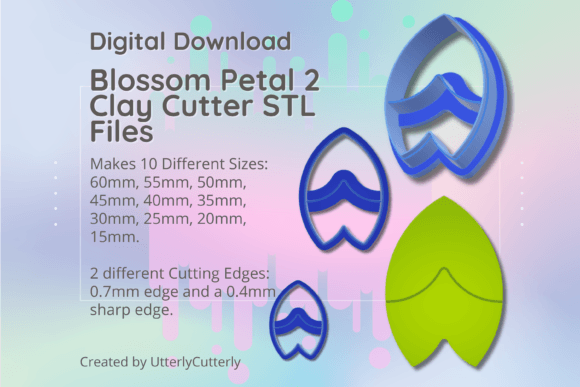
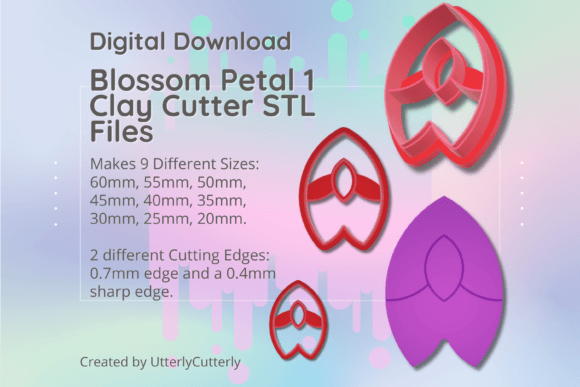
One of the most critical aspects of working with this STL file set is understanding the distinction between the two included cutter types. Not all projects require the same blade geometry, and using the incorrect profile can lead to torn clay, excessive cleanup time, or damaged fondant. The pack includes both a standard 0.7mm wall cutter and a Sharp Edge (SE) variant, each serving a distinct purpose in your workflow.
The Sharp Edge (SE) files feature a 1mm support wall tapering down to a precise 0.4mm cutting edge. This profile is engineered for detailed work where clean lines are paramount. When creating earrings or pendants from polymer clay, the SE cutter slices through the material with minimal resistance, reducing the distortion that often occurs with thicker blades. This results in less post-processing sanding and preserves delicate surface textures. Conversely, the 0.7mm wall cutter offers greater structural rigidity. While it leaves a slightly wider cut line, its robustness makes it ideal for denser materials like cookie dough or stiff fondant. The thicker wall prevents the cutter from flexing under pressure, ensuring the blossom shape maintains its integrity even when pressing into resistant mediums.
Both cutter types share a standardized 3mm thick base and a 12mm height. This uniformity is intentional; the wide base provides a comfortable grip surface for your thumb, distributing pressure evenly across the tool. This ergonomic consideration reduces hand fatigue during long production runs, a common pain point for small business owners fulfilling bulk orders. Understanding these mechanical differences allows you to select the correct STL file before printing, saving filament and time.
Scaling Designs with Nine Precision Sizes
Versatility in design is essential for creators looking to build cohesive collections. A single earring design may need to be scaled down for studs or scaled up for statement pieces. The Clay Cutter STL File Blossom Petal 1 addresses this need by providing nine graduated sizes: 60mm, 55mm, 50mm, 45mm, 40mm, 35mm, 30mm, 25mm, and 20mm. It is important to note that these measurements refer to the longest ends of the petal, not necessarily the width.
This granular sizing system supports several practical applications. For jewelry makers, the 20mm and 25mm sizes are optimal for lightweight stud earrings or charm components, while the 50mm to 60mm range serves as the foundation for barrettes, hair clips, or large pendants. Having intermediate sizes like 35mm and 40mm allows for subtle variations within a product line, enabling you to offer "small," "medium," and "large" options without redesigning the core aesthetic. For culinary artists, this range facilitates tiered cake decoration, where larger blossoms anchor the design and smaller petals create trailing accents. Because these are digital files, you can print only the sizes you currently need and return to the library later as your product offerings evolve.
Technical Considerations for Embossing and Print Quality
While the primary function of these files is cutting, users must be aware of specific dimensional constraints regarding embossing features. If the selected design includes internal embossing lines, they stand at 10.5mm tall. Given the total cutter height of 12mm, this leaves a clearance of only 1.5mm. This specification dictates your material preparation: you must use clay thicker than 1.5mm to prevent the embossing detail from punching completely through the workpiece.
Failing to account for this tolerance is a common error that ruins otherwise perfect pieces. Before printing, verify your typical slab thickness. If you consistently roll clay to 1mm or 1.2mm for delicate work, the embossed version of this cutter will not function as intended. In such cases, utilize the non-embossed outline files or adjust your rolling technique. Additionally, because these cutters are designed for easy printing, ensure your printer is calibrated for dimensional accuracy. A 0.4mm sharp edge requires proper flow rate tuning; over-extrusion can fuse the blade edge, rendering it dull, while under-extrusion may cause layer separation. Running a tolerance test print with the smallest size (20mm) is recommended before committing to a full batch of larger cutters.
Streamlining Production for Makers and Educators
The value of the Clay Cutter STL File Blossom Petal 1 extends beyond the shape itself; it lies in the autonomy it grants the user. For small business owners and freelancers, relying on third-party suppliers for niche tools introduces supply chain risks. Shipping delays, out-of-stock items, and discontinued designs can halt production. By possessing the master digital files, you decouple your creative output from external logistics. If a cutter breaks during a busy holiday season, you can print a replacement in under an hour rather than waiting days for a delivery.
Educators and workshop leaders also benefit significantly from this digital format. Teaching polymer clay or fondant techniques often requires multiple identical tools so students can practice simultaneously. Purchasing ten physical cutters can be cost-prohibitive, whereas printing a set from STL files drastically reduces the per-unit cost. Furthermore, new STL files are added to the store weekly, allowing educators to keep curriculum fresh and aligned with seasonal trends without reinvesting heavily in physical inventory. This model supports a sustainable, on-demand approach to tool acquisition that aligns with modern maker economics.
Understanding Digital Delivery and Usage Rights
Prospective users must recognize that this is strictly a digital product. No physical item will be shipped. Access to the files is granted immediately after payment confirmation, allowing for instant utilization. This immediacy is crucial for last-minute project adjustments or spontaneous creative sessions. However, it also places the responsibility of file management and print execution squarely on the user.
Before purchasing, assess your current 3D printing capabilities. These files are optimized for FDM (Fused Deposition Modeling) printers commonly used in maker spaces and home studios. Resin printers can also produce these cutters with exceptional detail, though the resin must be food-safe if intended for culinary use. Always verify material safety certifications for any application involving direct food contact. For jewelry and non-food crafts, standard PLA or PETG filaments provide an excellent balance of stiffness and ease of printing. By understanding the technical requirements and the digital nature of the Clay Cutter STL File Blossom Petal 1, creators can confidently integrate this resource into their workflow, transforming raw digital data into tangible, beautiful objects with efficiency and precision.