Clay Cutter STL File Oval Trinket Ornament: A Practical Digital Asset Review
For makers and small business owners operating in the polymer clay and ceramics space, tooling is often the bottleneck between a creative concept and a scalable product line. The Clay Cutter STL File Oval Trinket Ornament bundle addresses this friction point by providing a versatile, digital-first solution for producing consistent oval forms. Rather than purchasing pre-manufactured cutters that may lack specific dimensions or edge profiles, this digital download allows users to fabricate their own tools tailored to exact production requirements. This review evaluates the technical specifications, practical utility, and workflow integration of this STL bundle for professionals and serious hobbyists who own 3D printers.
Technical Specifications and Printability
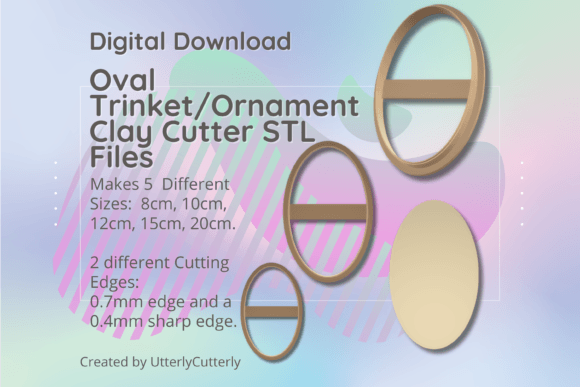
The primary value proposition of any cutter STL file lies in its geometry. A poorly designed file results in failed prints, excessive post-processing, or tools that damage the clay. This bundle distinguishes itself through specific engineering choices aimed at FDM (Fused Deposition Modeling) printing reliability. The inclusion of two distinct cutting edge profiles acknowledges that different materials and finishes require different tool geometries.
- Standard Edge: Features a 0.7mm wall thickness with a 3mm thick base and 12mm height. This profile offers structural rigidity, making it suitable for stiffer clays or repetitive production runs where durability is prioritized over an ultra-fine cut.
- Sharp Edge (SE): Abbreviated as SE in the filenames, this variant utilizes a 1mm support wall tapering to a 0.4mm cutting edge. It maintains the same 3mm base and 12mm height but is engineered for cleaner slicing through softer polymer clays, reducing drag and deformation.
The 12mm height across both variants is a deliberate design choice. It provides sufficient clearance for knuckles during use while maintaining enough surface area for grip. Furthermore, the 3mm base thickness ensures the cutter remains flat on the build plate during printing, significantly reducing the risk of warping or bed adhesion issues common with thinner-walled objects. For users printing in PLA or PETG, these dimensions strike a functional balance between print speed and tool longevity.
Size Versatility and Production Scaling
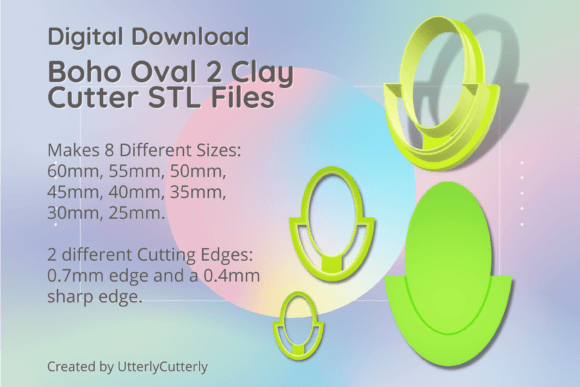
Consistency is critical when creating collections, whether for jewelry lines, holiday ornaments, or trinket dishes. This bundle includes five discrete sizes: 8cm, 10cm, 12cm, 15cm, and 20cm. Note that these measurements refer to the longest dimension of the oval. Having a graduated set within a single digital package eliminates the guesswork of sourcing complementary sizes from different vendors.
From a production standpoint, this size range covers the majority of standard applications. The 8cm and 10cm variants are ideal for earrings, pendants, and small ring dishes. The 12cm and 15cm sizes serve well for statement necklaces, coasters, and medium trinket trays. The 20cm option extends the utility to larger wall hangings or serving platters. Because these are digital files, users can also scale them within their slicer software if a non-standard size is required, though the provided dimensions are optimized for the intended wall thicknesses.
Embossing Compatibility Considerations
A crucial technical detail for users incorporating texture into their work involves the embossing line height. If the selected STL variant includes embossing details, they are designed at 10.5mm tall. This specification dictates material preparation: clay must be conditioned to a thickness greater than 1.5mm to fully engage the embossing without bottoming out. Users working with thin sheets for delicate jewelry should verify their roller settings before cutting to ensure the textured impression registers correctly. This level of dimensional transparency in the product description prevents wasted material and failed test cuts.
Workflow Integration and Material Applications
The versatility of the oval shape makes this Clay Cutter STL File Oval Trinket Ornament bundle applicable across multiple mediums. While primarily marketed for polymer clay, the geometry is equally effective for cookie dough, fondant, and ceramic slabs, provided the appropriate edge profile is selected.
Polymer Clay and Jewelry Making: The Sharp Edge (SE) variant is recommended here. The 0.4mm tip slices through conditioned clay with minimal resistance, preserving the integrity of blended colors or mica shifts. The smooth oval form serves as a foundational canvas for silkscreening, stamping, or resin inlay work.
Ceramics and Pottery: The Standard Edge is preferable for slab building. The thicker 0.7mm wall resists bending when pressed into leather-hard clay. The 20cm size is particularly useful for creating uniform oval platters or decorative wall tiles where hand-cutting would result in asymmetry.
Baking and Confectionery: Both edge types are food-safe when printed in appropriate materials like PETG or food-safe PLA. The oval geometry offers a classic aesthetic for cookies and fondant decorations that differs from standard round or rectangular cutters found in retail stores.
Evaluating Long-Term Value and Customization
Digital fabrication assets differ fundamentally from physical tools in terms of lifecycle value. Once acquired, this STL bundle becomes a permanent part of the maker’s digital library. There is no shipping delay, no risk of discontinued products, and no degradation of the master file. If a cutter breaks during production, a replacement can be printed in under an hour. This resilience is invaluable for businesses fulfilling wholesale orders or meeting seasonal deadlines.
Furthermore, the bundle is designed to integrate with a broader ecosystem. The description notes that new STL files are added weekly and that these ovals are sized to curate custom combos with other shapes. For entrepreneurs building a cohesive brand identity, having access to a consistently designed library of cutters ensures that all products share proportional harmony. This interoperability reduces the cognitive load of design planning and streamlines the prototyping phase.
Practical Recommendations and Limitations
While this digital asset offers significant advantages, prospective users should approach it with realistic expectations regarding hardware requirements and post-processing.
- Printer Calibration: Achieving a functional 0.4mm cutting edge requires a well-calibrated printer. Users should verify their flow rate and extrusion width settings. Over-extrusion will blunt the sharp edge, negating the benefit of the SE variant. A 0.4mm nozzle is standard, but tuning retraction and cooling is essential to prevent stringing on the thin walls.
- Post-Processing: Even with optimal print settings, layer lines may be visible on the cutting face. For professional-grade clay work, lightly sanding the cutting edge with high-grit sandpaper (600-1000 grit) is recommended to ensure a glass-smooth finish that releases cleanly from raw clay.
- Material Safety: As this is a digital file, food safety depends entirely on the user’s choice of filament and printer maintenance. Standard brass nozzles can leach heavy metals; stainless steel nozzles and certified food-safe filaments are mandatory for culinary applications.
- Design Constraints: The fixed 12mm height and base dimensions are optimized for general use but may not suit every niche application. Users requiring deeper cutters for thick ceramic slabs or shallower ones for paper crafts will need to modify the STL in CAD software, which requires additional technical skill.
Assessing Fit for Your Creative Practice
The Clay Cutter STL File Oval Trinket Ornament bundle represents a pragmatic investment for makers who view tooling as an integral part of their production pipeline rather than an afterthought. It is best suited for individuals who already possess 3D printing capability and understand basic slicer operations. Beginners without printing experience may find the learning curve steep, whereas established creators will appreciate the immediate utility and precise specifications.
For small business owners, the return on investment is calculable: the cost of the digital file is typically less than a single physical cutter, yet it yields unlimited replacements and five distinct sizes. For educators and workshop leaders, the ability to print dozens of identical cutters overnight facilitates group activities without prohibitive supply costs. Ultimately, this resource supports a shift toward self-sufficient manufacturing, granting creators greater control over their tools, timelines, and product quality. By evaluating your specific material needs, printer capabilities, and production volume against the technical specs outlined above, you can determine whether this digital asset aligns with your operational goals.