Butterfly Wing 1 Earring Charm STL File: A Practical Guide to Printing and Resin Casting
Creating custom jewelry and accessories at home requires more than just a 3D printer; it demands digital assets designed specifically for post-processing and casting. The Butterfly Wing 1 Earring Charm STL File serves as a versatile foundation for makers who want to bridge the gap between modern fabrication and vintage aesthetics. This digital download provides a master mold design intended to be printed, filled with resin, and transformed into finished pieces ranging from delicate earrings to substantial wall hangings. Understanding how to leverage this specific file type prevents wasted filament, failed casts, and frustration during the finishing stages.
Understanding the Versatility of Multi-Scale Designs
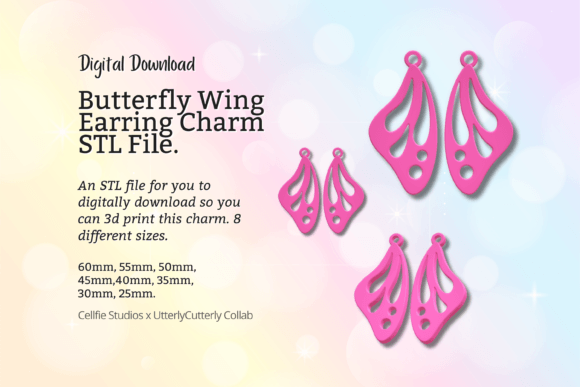
A common oversight when purchasing jewelry STL files is assuming a single scale will suffice for all projects. Jewelry making is highly dependent on proportion relative to the human body or the intended display space. This pack addresses that limitation by including eight distinct sizes: 60mm, 55mm, 50mm, 45mm, 40mm, 35mm, 30mm, and 25mm. These measurements refer strictly to the wing span or height and do not include loop holes, which is a critical distinction for planning your final dimensions.
Makers often make the mistake of scaling a single file up or down in their slicer software rather than using pre-sized versions. While scaling seems convenient, it frequently distorts intricate details. Enlarging a 25mm model to 60mm can result in pixelated edges and weak structural points, while shrinking a 60mm model to 25mm may cause delicate veins to fuse together during printing. Utilizing the dedicated size variants included in this download ensures that the wall thickness and detail resolution remain optimized for each specific dimension. The larger 60mm and 55mm sizes are engineered with deeper channels suitable for wall hangings and Christmas ornaments, while the 25mm to 40mm range maintains the precision necessary for earrings, necklaces, and keyrings.
Avoiding Slicing Errors for Resin Molds
The primary function of this Butterfly Wing 1 Earring Charm STL File is to act as a positive master for creating silicone molds or direct resin casts. A frequent error occurs when users apply standard decorative printing settings to functional mold masters. If you print with low infill or insufficient perimeters, the surface texture of the print will transfer directly into your resin piece. Layer lines that are acceptable for a painted figurine will look like defects in a translucent resin earring.
To achieve a professional finish, adjust your slicer settings before hitting print. Increase your wall count to at least four or five perimeters to ensure a smooth outer shell. Use a higher infill percentage, typically above 40%, to prevent the top layers from sagging over gaps. For FDM printers, consider using a smaller nozzle diameter, such as 0.2mm or 0.3mm, to capture the finer details of the butterfly wing texture. If you are using a resin printer for the master itself, ensure your exposure times are calibrated to avoid over-curing, which can swell the details and alter the fit of your eventual findings.
Always perform a test print of the smallest size (25mm) first. This uses minimal material and time but reveals whether your current settings can handle the finest details of the design. If the small version prints cleanly, the larger versions will almost certainly succeed. Skipping this validation step is a leading cause of material waste for hobbyists and small business owners alike.
Planning for Findings and Assembly
It is vital to remember that the provided measurements exclude loop holes. Many creators have printed a charm only to realize there is no integrated geometry for attaching earring hooks or keyring chains. This is intentional, as it allows you to customize the attachment method based on your preferred hardware. However, failing to plan for this can ruin an otherwise perfect print.
Before printing, decide how you will attach findings. If you intend to drill holes post-print, select a size that offers enough solid material near the edge to support drilling without cracking. If you plan to embed a metal bail or wire loop directly into the resin during casting, ensure the printed master has adequate clearance or texture to hold the hardware securely. For those using this file to create silicone molds, consider adding registration keys or alignment marks to your print if you are doing two-part casting, although this specific design is generally suited for open-face or simple press molds depending on the depth of the relief.
Evaluating Quality and Commercial Viability
For entrepreneurs and sellers, the reliability of a digital asset is as important as its aesthetic appeal. All our 3D products undergo testing as part of a standard quality-checking system before being listed. This reduces the risk of downloading corrupted geometry or non-manifold meshes that fail during slicing. However, "tested" does not mean "universal." Printer calibration varies significantly between brands and even individual machines.
When evaluating this file for commercial production, verify that your specific printer can reproduce the vintage texture accurately. A design that looks beautiful on screen but prints with poor layer adhesion will result in brittle jewelry that breaks during demolding or wear. Test the mechanical strength of the thinnest sections, especially on the 25mm and 30mm variants intended for earrings. If the wings snap easily under light pressure, increase your perimeter count or switch to a tougher filament like PETG or ABS for the master mold, rather than standard PLA.
New STL files are added to our store weekly, allowing you to build a cohesive collection. When expanding your inventory, maintain consistent printing parameters across different designs to ensure uniform quality. Customers notice when one earring charm feels substantially different from another due to varying print resolutions or material choices. Establishing a standardized workflow for these digital downloads helps maintain brand consistency and customer trust.
Managing Digital Assets and Expectations
Please be aware that this is strictly a digital download. No physical item will be shipped to you. Access to the files is granted immediately after payment confirmation. A common administrative mistake is assuming technical support includes troubleshooting your specific printer hardware. While the files are verified to be geometrically sound, successful printing depends entirely on your equipment maintenance, bed leveling, and material quality.
Organize your downloaded files systematically. With eight sizes included, mislabeling a 45mm file as a 50mm file can lead to mismatched pairs in earring production. Create a folder structure that mirrors the product description, keeping the original STLs separate from any modified or sliced versions. This practice saves time when you need to reprint a specific size months later and prevents accidental overwriting of the master geometry.
This Butterfly Wing 1 Earring Charm STL File offers a balance of artistic flair and functional utility for the home maker. By respecting the technical requirements of mold-making, utilizing the provided size variations correctly, and validating your printer settings before full production runs, you transform a simple digital file into a reliable stream of handmade goods. Whether you are crafting a personal gift or stocking an online shop, attention to these practical details distinguishes amateur attempts from professional results.