7.5mm Wide Bezel Square 1 Clay Cutter: Strategic Asset for Digital Fabrication
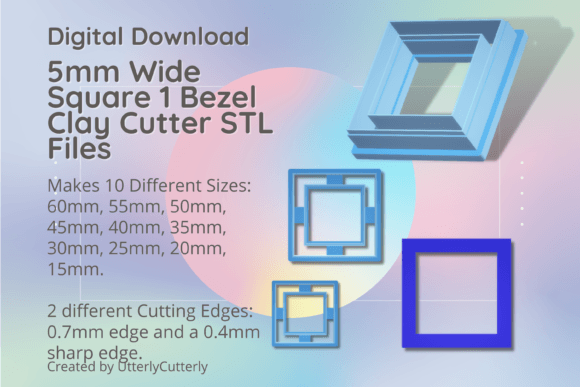
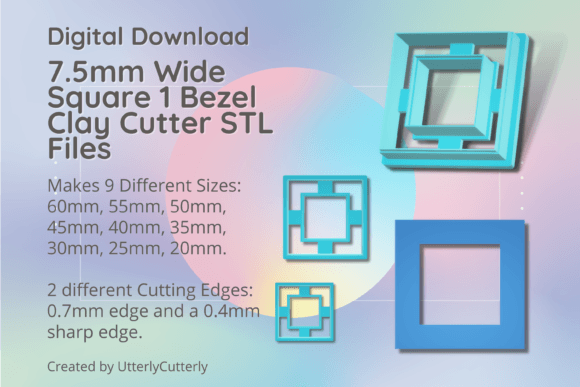
The 7.5mm Wide Bezel Square 1 Clay Cutter represents more than a simple shaping tool; it is a foundational component in a digital fabrication workflow designed for precision, consistency, and scalability. For creators, small business owners, and hobbyists utilizing 3D printing technology, this digital STL file bundle offers a strategic advantage in producing uniform bezel frames. Unlike physical tools that degrade over time or require shipping logistics, this digital asset allows for immediate, on-demand production of cutters tailored to specific project requirements. The ability to print nine distinct sizes ranging from 20mm to 60mm ensures that your inventory of tools can expand instantly to meet client demands or creative exploration without additional capital expenditure beyond filament and machine time.
Strategically, adopting digital cutter files like the 7.5mm Wide Bezel Square 1 Clay Cutter shifts the operational model from acquisition to creation. This transition supports better margin control and faster prototyping cycles. Whether you are manufacturing polymer clay jewelry, fondant decorations, or cookie art, the consistency provided by a digitally fabricated edge eliminates human error in hand-cutting. This reliability is essential for branding; when customers expect a specific aesthetic or dimension, digital standardization guarantees that every piece meets that expectation. Understanding the technical specifications and strategic applications of this file set is crucial for maximizing return on investment and maintaining high-quality output in a competitive maker market.
Technical Specifications and Printability as Operational Assets
To leverage the 7.5mm Wide Bezel Square 1 Clay Cutter effectively, one must understand the engineering behind the STL files. This bundle is not a monolithic design but a curated system offering two distinct cutting edge profiles, each serving a specific functional purpose. Recognizing the difference between these profiles is a critical decision point in your production planning.
- Standard Wall Profile: Features a 0.7mm wall thickness with a 3mm thick base and a total height of 12mm. This profile offers durability and rigidity, making it ideal for stiffer clays or repeated commercial use where tool longevity is prioritized over extreme sharpness.
- Sharp Edge (SE) Profile: Abbreviated as SE in the file names, this variant includes a 1mm support wall tapering to a 0.4mm cutting edge. It shares the same 3mm base and 12mm height but provides superior slicing capability for delicate materials or intricate detailing where clean release is paramount.
Both profiles are engineered for ease of printing, reducing failed prints and material waste. The 12mm height is a deliberate design choice, accommodating clay slabs thicker than 1.5mm while allowing sufficient grip for the user. When embossing lines are present, they stand at 10.5mm, ensuring they engage properly with standard slab depths. By selecting the appropriate profile for your specific material viscosity and desired finish, you optimize both the lifespan of the printed tool and the quality of the final product. This level of technical granularity transforms a generic cutting task into a controlled manufacturing process.
Aligning Tool Selection with Product Development Goals
Possessing the 7.5mm Wide Bezel Square 1 Clay Cutter files is only the first step; integrating them into a cohesive product strategy drives value. The inclusion of nine sizes—60mm, 55mm, 50mm, 45mm, 40mm, 35mm, 30mm, 25mm, and 20mm—facilitates versatile collection planning. Rather than viewing these as isolated tools, consider them as modules for building scalable product lines.
For jewelry makers, the graduated sizing enables the creation of nested sets or size-inclusive earring collections. A 20mm cutter might serve as a stud earring component, while the 60mm version functions as a statement pendant. This modularity reduces design friction; instead of sourcing new tools for every variation, you utilize existing assets to expand your catalog. In culinary applications, such as cookies or fondant, the size range allows for tiered pricing strategies or customizable event packages. The 7.5mm wide bezel specifically creates a substantial frame that acts as a canvas for further embellishment, resin fills, or surface treatments, distinguishing your work from competitors using thinner, less distinctive borders.
Planning should also account for the "donut" shape geometry. This negative space is as valuable as the outer frame. Strategically, this opening reduces material costs per unit and decreases curing or baking times compared to solid shapes. For entrepreneurs, these efficiencies compound over large production runs, directly impacting profitability. Furthermore, the square geometry with rounded internal corners (implied by the donut/bezel description) offers a modern aesthetic that bridges the gap between geometric minimalism and organic softness, appealing to contemporary design sensibilities.
Risk Mitigation and Intentional Usage
While digital fabrication offers immense flexibility, relying on the 7.5mm Wide Bezel Square 1 Clay Cutter without clear context introduces risks. A common pitfall is printing all variations without testing material compatibility. The 0.4mm Sharp Edge, while precise, may be too fragile for dense porcelain clay or stiff gum paste, leading to breakage during use. Conversely, the 0.7mm wall might drag or distort soft polymer clay if not conditioned properly. Before committing to bulk production, conduct small-batch tests with your specific media to determine which profile yields the best balance of cut quality and tool durability.
Another risk involves printer calibration. Although these files are designed for easy printing, layer adhesion and dimensional accuracy depend on your machine’s tuning. A poorly calibrated printer may produce cutters that are slightly undersized or have rough layer lines that transfer texture to the clay unintentionally. Treat the first print of any new size as a prototype. Measure the longest ends to verify they match the stated dimensions (e.g., confirming a 50mm cutter actually measures 50mm). Documenting these calibration settings creates a standardized operating procedure, ensuring that replacement cutters printed months later remain identical to the originals. This consistency is vital for long-term brand integrity and customer trust.
Expanding Capabilities Through Digital Ecosystems
The true strategic power of the 7.5mm Wide Bezel Square 1 Clay Cutter lies in its interoperability within a broader digital ecosystem. This pack is designed to curate custom combos easily with other STL files. New designs are added weekly, suggesting a living library rather than a static purchase. Smart creators build their toolsets incrementally, acquiring complementary shapes, textures, and embossers that fit the 7.5mm bezel standard.
This approach supports agile product development. Instead of investing heavily in physical molds that may become obsolete, you maintain a digital inventory that adapts to trends. If market demand shifts toward textured surfaces, you can download and print compatible texture sheets that align with your existing bezel cutters. If seasonal trends require specific motifs, you can integrate those elements without disrupting your core production workflow. This agility is particularly valuable for freelancers and small business owners who must pivot quickly to stay relevant.
Furthermore, owning the digital files grants autonomy. You are not dependent on supplier stock levels or international shipping delays. If a cutter breaks mid-production, a replacement can be fabricated in hours. This resilience strengthens operational continuity and reduces downtime. For educators and workshop leaders, this accessibility means students can learn not just crafting techniques, but also the principles of digital manufacturing and tool maintenance, adding educational value to the practical utility.
Decision Framework for Implementation
Before downloading and printing, apply this decision framework to ensure the 7.5mm Wide Bezel Square 1 Clay Cutter aligns with your current objectives:
- Define the Output: Are you making earrings, pendants, barrettes, cookies, or fondant? Each application has different tolerance requirements. Jewelry demands higher resolution (SE profile), while cookies may tolerate the standard wall.
- Assess Material Properties: Test both cutter profiles with your primary medium. Document which performs best regarding release, edge definition, and durability.
- Evaluate Scale Needs: Do you need the full range of 9 sizes immediately, or will a subset suffice? Printing only necessary sizes conserves filament and storage space.
- Verify Printer Readiness: Ensure your bed leveling and nozzle diameter are optimized for fine details. A 0.4mm nozzle is generally recommended for these tolerances.
- Plan for Post-Processing: Even well-printed cutters may require light sanding or acetone smoothing (for ABS/ASA) to achieve a glass-smooth finish on clay. Factor this labor into your production timeline.
By approaching the 7.5mm Wide Bezel Square 1 Clay Cutter with intentionality, you transform a simple digital download into a robust production asset. The combination of precise engineering, versatile sizing, and digital accessibility empowers creators to build sustainable, scalable practices. Success in modern crafting and small-scale manufacturing depends not just on artistic vision, but on the strategic selection and management of tools. This STL bundle provides the technical foundation upon which consistent quality, efficient operations, and distinctive branding can be built. Remember, this is a digital file, not a physical item; your results depend entirely on your printer's capabilities and your thoughtful application of these resources. Use them wisely to craft not just objects, but a resilient creative enterprise.